
Komodo Dragon Behaviour: How Wild Dragons Spend Their Day
Komodo dragon behaviour: daily routine, body heat, senses, hunting, fighting, how far dragons roam and how they behave around people.
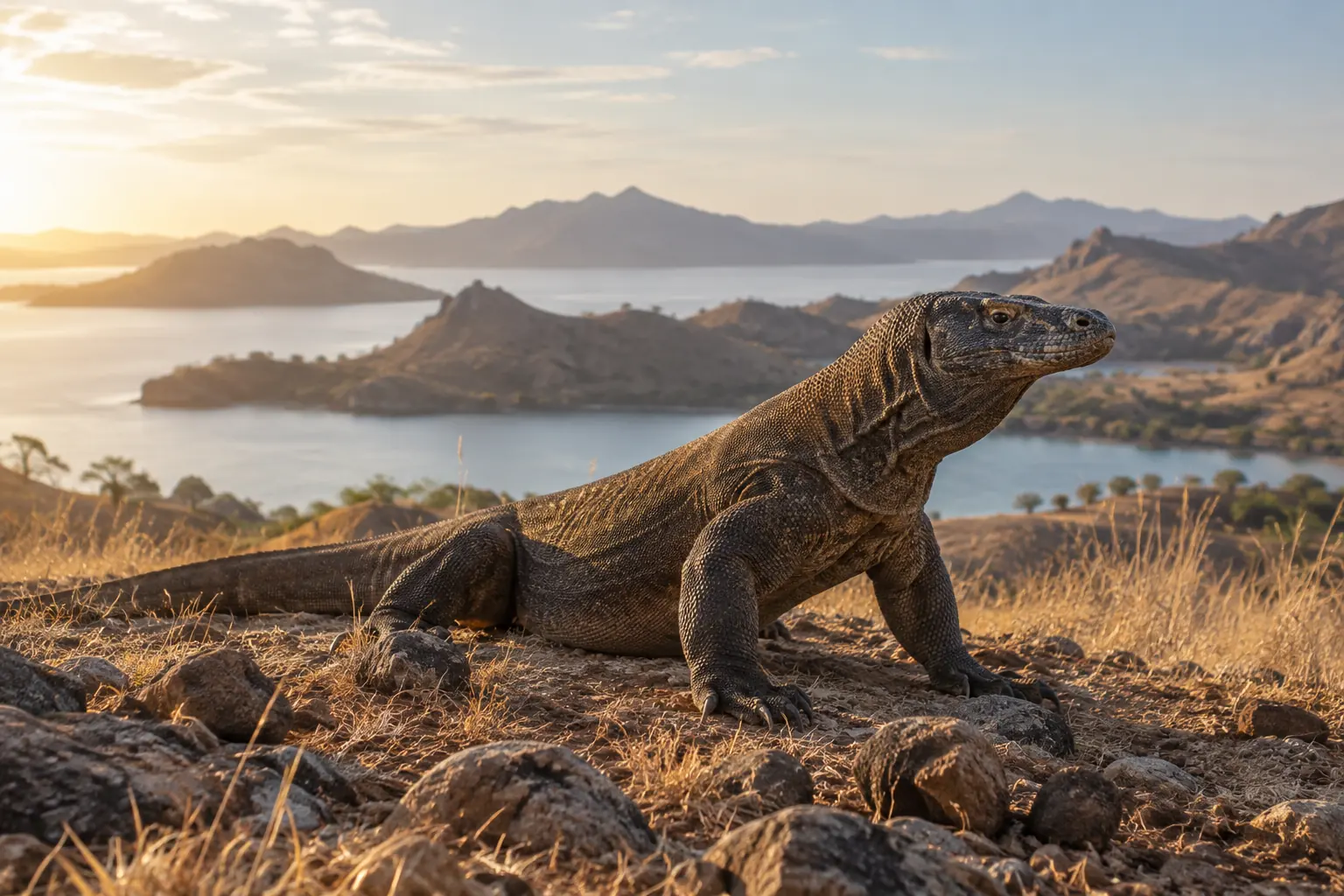
Komodo dragons are solitary, cold-blooded predators whose day is ruled by temperature. They leave their burrows to bask after sunrise, hunt or scavenge while it is still cool, rest in the shade through the midday heat and retreat again towards dusk. They can sprint in short bursts, swim and, when young, climb trees, but most adults spend their whole lives within the valley where they hatched.
Watch a dragon for ten minutes on a ranger-led trek and you might see very little happen. That stillness is the key to Komodo dragon behaviour: a large, cold-blooded predator that spends most of its energy staying at the right temperature and waiting for food to come to it. This guide explains how wild dragons spend their day, how they sense prey, how far they travel, and what their behaviour means for visitors.
Movement and sprint context reviewed 16 October 2026 against the linked field study and zoological reference. The study results are not measurements made by KomodoInsider.
This guide focuses on daily activity, movement, hunting and responses to people. For the broader species overview—including biology, reproduction, venom and common misconceptions—read our Komodo dragon facts.
A Komodo dragon’s day
| Time of day | Typical behaviour | What you might see on a trek |
|---|---|---|
| After sunrise | Leaves the burrow and basks to warm up | Dragons lying flat in the sun, often near ranger stations |
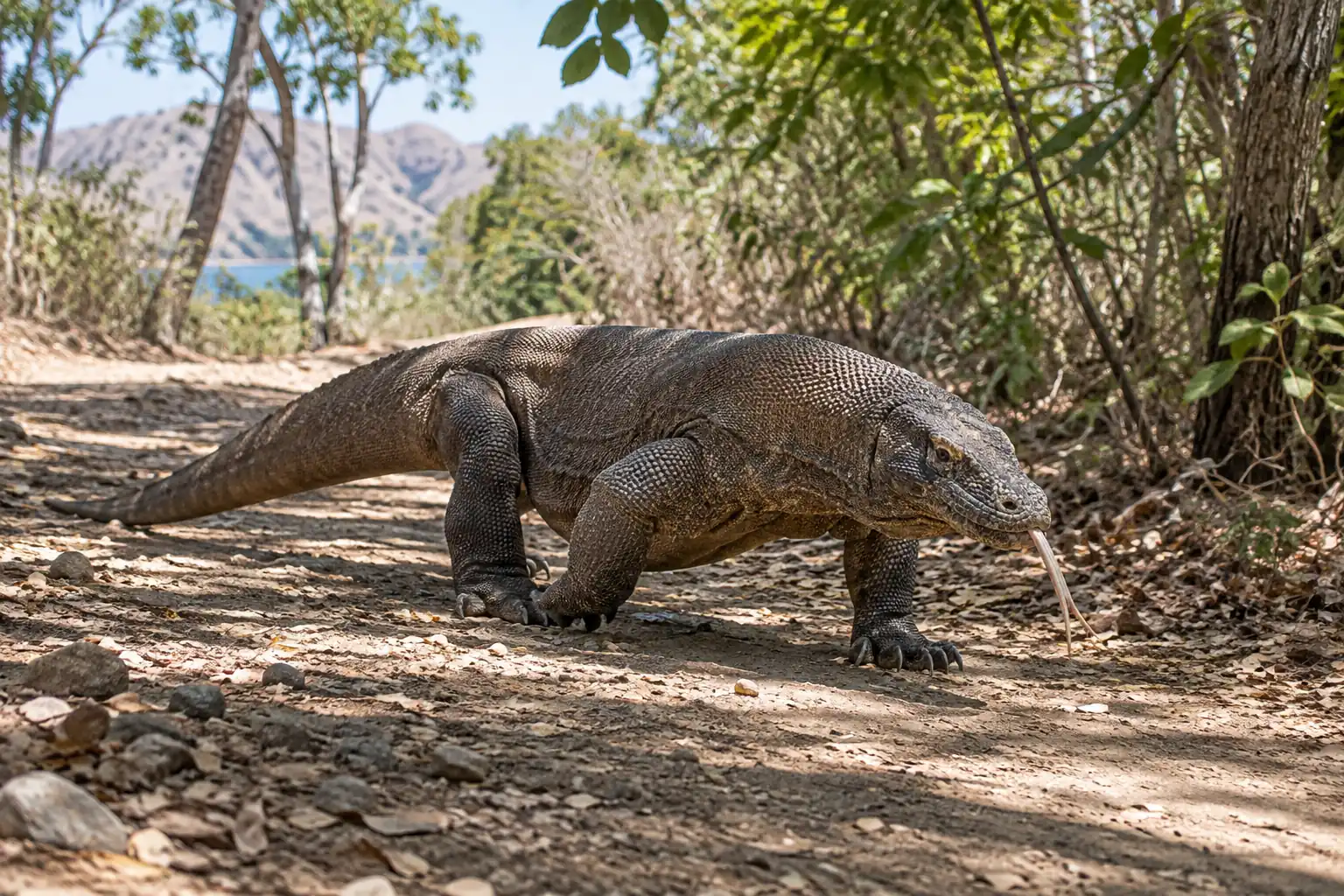
| Morning | Most active period: patrolling, hunting and scavenging | Walking dragons, frequent tongue-flicking |
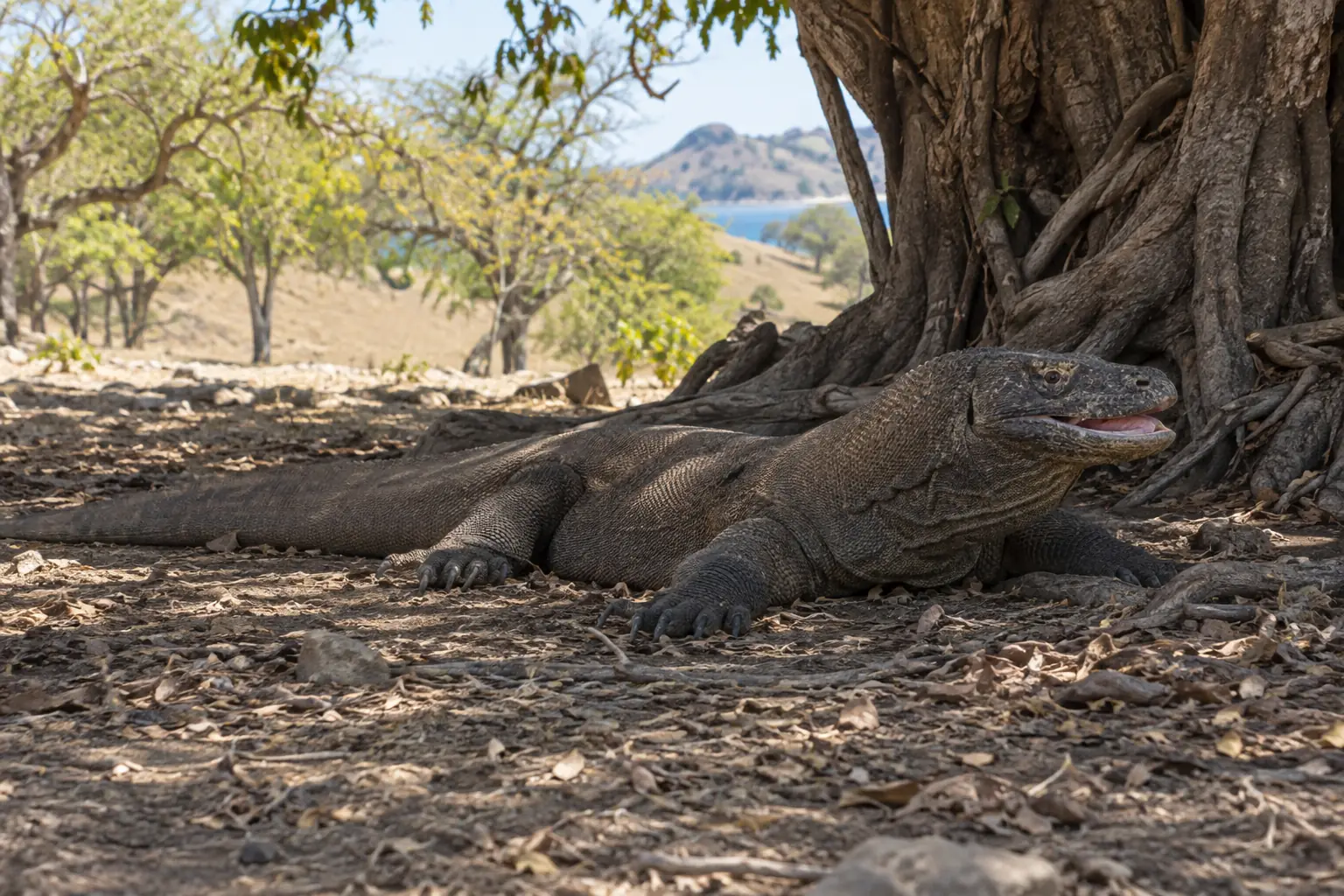
| Midday | Rests in shade; may gape with the mouth open to cool down | Dragons under trees or buildings, barely moving |
| Late afternoon | A shorter second activity period | Occasional movement and feeding |
| Night | Back in a burrow or sheltered spot | Nothing; treks run in daylight only |
This pattern is why early treks tend to show more activity. By late morning most dragons have moved into deep shade.
Body temperature: why heat controls everything
Like all reptiles, Komodo dragons rely on their surroundings to regulate body temperature. A field study of free-ranging dragons found that small, medium and large animals all kept a similar preferred body temperature of about 35°C, but reached it in different ways.
Small dragons shuttled between sun and shade far more often and spent more time exposed. Large dragons were more sedentary: they relied on choosing the right spot, such as a shaded hollow or a burrow, and on gaping with their mouths open to cool through evaporation. The researchers suggested this difference helps explain why young dragons forage actively while big adults hunt by sitting and waiting.
Burrows matter too. Adult dragons dig burrows or use existing ones to escape the midday heat and cool nights, and you may see the entrances beside trails on Rinca and Komodo.
How Komodo dragons sense the world
Smell leads almost everything a dragon does. It flicks its long, yellow, forked tongue to gather scent particles from the air, then presses the tips against a sensory organ in the roof of its mouth. If the signal is stronger on one side of the fork, the dragon knows which direction the smell is coming from. This is how dragons track wounded prey and find carcasses, and why a dragon on the trail is constantly tasting the air.
Hunting and feeding behaviour
Adult dragons are mainly ambush hunters. They wait beside game trails, rush passing deer or pigs, and deliver a slashing bite; venom and blood loss do the rest. They are also heavy scavengers, and several dragons often gather at a large carcass, where the biggest animals usually feed first. Our guides to what Komodo dragons eat and Komodo dragon venom cover this in detail.
Solitary, but not always alone
Komodo dragons live and hunt alone for most of the year. They come together in two situations: at large carcasses, and during the breeding season, roughly June to August.
In the breeding season, rival males fight for access to females. They rear up on their hind legs, propped on their tails, and grapple with their forelimbs until one is pushed over. These contests can leave bite wounds, which dragons seem to tolerate well; see our Komodo dragon reproduction guide for what happens next.
How far do Komodo dragons roam?
Jessop and colleagues (2018) used telemetry to study movement, including 22 animals with five recorded positions per day. Some 16–22 kg animals averaged about 2.5 km of movement per day, while observed daily totals could reach 11 km. These are results from a defined sample and tracking interval, not a daily distance rule for every dragon.
Yet over a lifetime, dragons hardly disperse at all. A long-term study combining radio-tracking, experimental translocations, mark-recapture and genetics found that dragons rarely moved beyond the valleys where they were born or first caught. Dragons moved to the far end of their home island found their way back over a few months, while those released just across a narrow channel on another island simply settled there rather than swim home. In practice, the dragon you see at Loh Liang or Loh Buaya has probably spent its whole life within a few kilometres of that spot.
Can Komodo dragons run, swim and climb?
- Run: short bursts use a different timescale from daily movement. The facts guide explains reported sprint ranges; do not use a maximum as an escape strategy.
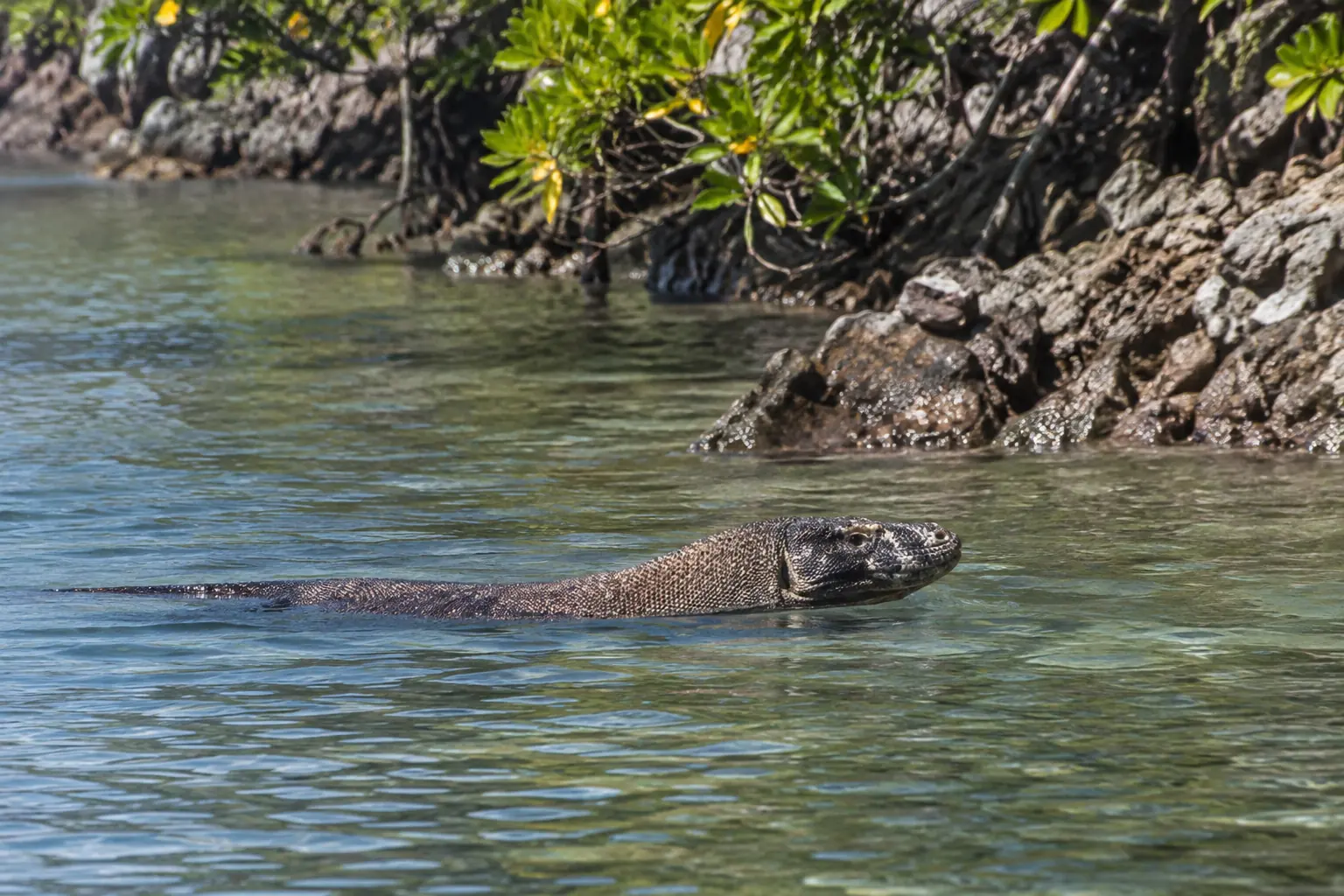
- Swim: yes, and well. Dragons swim with side-to-side movements of the body and tail, though they rarely choose to cross open water between islands.
- Climb: young dragons are expert climbers and live in trees for their first years. Adults are too heavy to follow them.
- Dig: yes. Adults dig burrows for shelter, and females dig nest chambers to lay eggs.
How dragons behave around people
Dragons in busy visitor areas are not typical. A 2018 study comparing sites across the park found that dragons exposed to tourism were noticeably less wary, as well as heavier and in better condition, which the authors linked to food scraps and other human-provided food. A calm dragon lying by a ranger station can still move suddenly, and reduced wariness makes it more, not less, important to keep your distance.
- Walk with the park naturalist guide and stay on the trail or boardwalk.
- Keep the distance the guide sets, even if the dragon looks asleep.
- Avoid sudden movements and never try to touch, feed or tease a dragon.
When comparing Komodo tour packages, choose a ranger-led route whose time ashore fits your group and the full boat day. For a day visit, compare the komodo one day tour and confirm the named ranger gateway; do not assume it includes both Komodo and Rinca. Activity varies with conditions and recent feeding, so an early trek is not a sighting guarantee.
Daily movement is not a sprint test
Adding distances between recorded positions estimates movement across that tracking interval. It does not time the fastest few seconds, capture every turn between fixes or establish how long an animal can maintain a maximum. Home-range area measures space used, not speed. Keep those quantities separate when interpreting a figure in a wildlife article.
The San Diego Zoo Wildlife Alliance behaviour reference separates walking and short-distance running. The broader Komodo dragon facts guide explains the reported sprint range and its limits; a brief burst is different from daily movement.
Frequently asked questions
Are Komodo dragons aggressive?
They are predators rather than aggressive by nature. Most avoid people, but a dragon can attack if approached, startled or attracted by food, which is why every visit is ranger-led.
Are Komodo dragons solitary?
Yes, for most of the year. They gather at large carcasses and during the breeding season, when males fight over females.
When are Komodo dragons most active?
In the morning, after they have warmed up in the sun. They rest in shade through the midday heat and are less active until late afternoon.
How fast can a Komodo dragon run?
Reference summaries report a short-burst running range, not a sustained daily pace. See the facts guide for the cited range and its measurement limits. Follow the ranger’s positioning rather than comparing your running speed.
Can Komodo dragons swim?
Yes, they are capable swimmers, but they rarely cross between islands and most stay in their home valley for life.
How far do Komodo dragons travel in a day?
There is no fixed distance for every animal. The 2018 telemetry study described in this article found size-related variation and substantial daily differences. Daily tracking distance is not a sprint-speed measurement.
Where do Komodo dragons sleep?
In burrows or sheltered spots. Adults dig burrows that protect them from the midday heat and the cool of the night.
Record behaviour without assigning a motive
Write what the animal did before naming why: resting in shade, tongue-flicking, walking across a trail or approaching a carcass. A short observation cannot establish hunger, aggression or the animal’s full daily routine. Weather and the group’s presence are useful context to note.
Keep the observation from the ranger’s permitted position. If the animal or group moves, follow the ranger instead of staying behind for a longer record. A useful field note should improve the description without changing the encounter.
For movement methods and their limits, see Jessop and colleagues’ 2018 tracking study.
