
Komodo Dragon Evolution: How an Australian Giant Ended Up on Flores
Komodo dragon evolution: Australian origins, fossils from Timor, Java and Flores, Megalania, what the genome shows and why dragons survive only here.
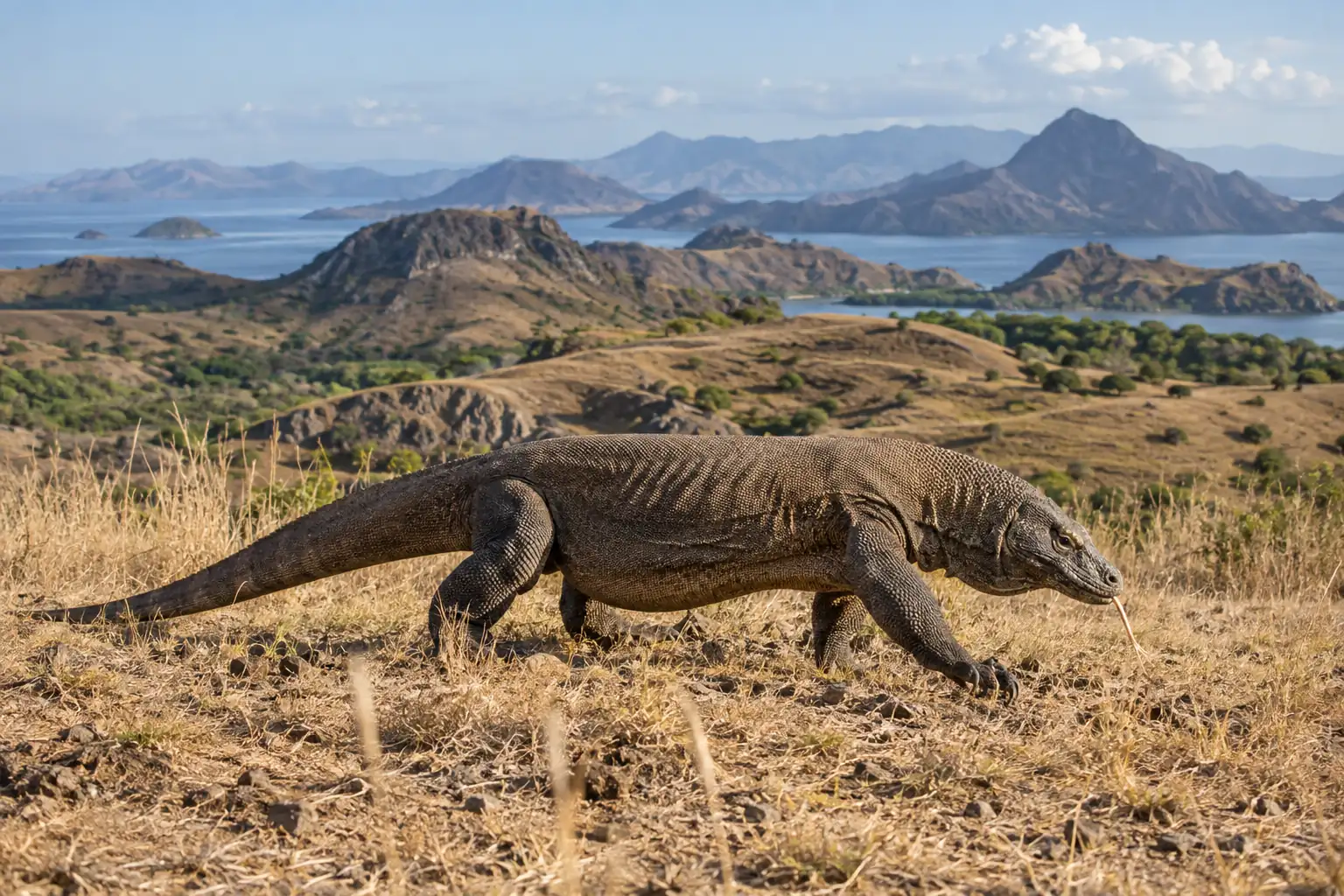
The key finding in Komodo dragon evolution is that these lizards did not become giants on the islands where they live today. Fossils show the lineage arose in Australia around 3 to 4 million years ago and spread west through the islands, reaching Flores by about 900,000 years ago. Their body size has changed little since then. Today they survive only on a handful of islands in and around Komodo National Park, a small remnant of a once much wider range.
For most of the 20th century, the Komodo dragon was the textbook example of island gigantism: a smaller lizard that grew huge after it reached islands with no large mammal predators. Fossil evidence published in 2009 turned that story around. This guide explains where Komodo dragons actually came from, which giant relatives lived alongside them, what their genome reveals, and why they survive only in one corner of Indonesia today.
Checked 24 September 2026 against the research listed at the end of this guide.
Komodo dragon evolution: the timeline
| When | What happened |
|---|---|
| About 3 to 4 million years ago | Giant monitor lizards, including the Komodo dragon lineage, live in Australia alongside the even larger Megalania |
| Early Pleistocene | The lineage spreads west through the islands between Australia and Asia; a separate, larger giant monitor lives on Timor |
| By about 900,000 years ago | Komodo dragons are established on Flores, and their body size stays broadly stable from then on |
| About 880,000 years ago | Early humans arrive on Flores and share the island with dragons |
| By about 10,000 years ago | Modern humans are present on Flores |
| Last 2,000 years | The dragon’s range contracts severely |
| 1912 | The species is formally described by science as Varanus komodoensis |
Where did Komodo dragons come from?
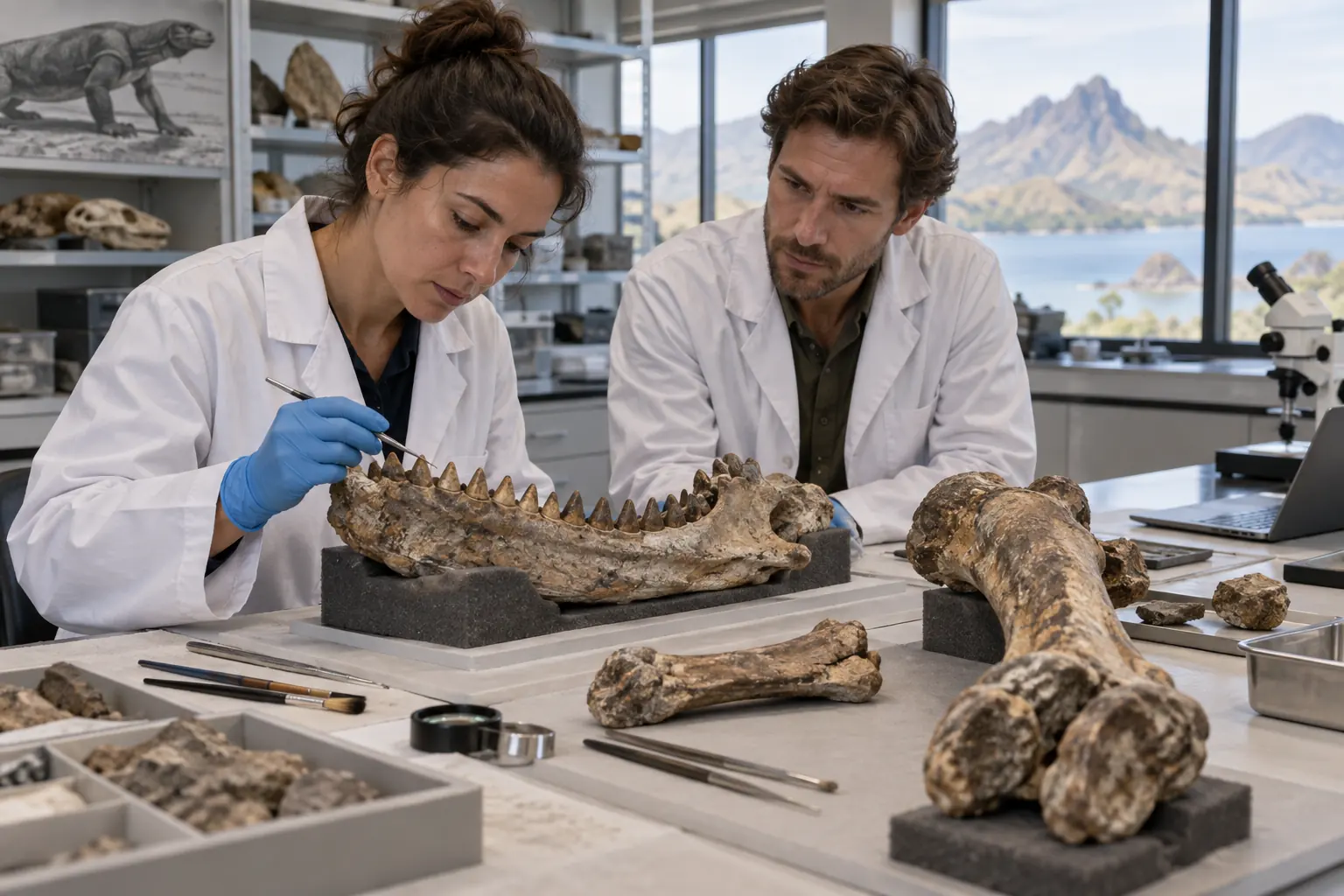
A team led by Scott Hocknull of the Queensland Museum compared giant monitor fossils from Australia, Timor, Flores, Java and India. Their 2009 study in PLOS ONE concluded that the ancestor of the Komodo dragon most likely evolved in Australia and dispersed westward, reaching Flores by around 900,000 years ago. Fossil material from mainland Australia placed the lineage there roughly 3.8 million years ago, long before it reached the islands of Wallacea.
That makes the Komodo dragon an Australian export rather than an Indonesian invention. As Hocknull put it, Australia was the birthplace of the three-metre Komodo dragon, not only of its five-metre cousin Megalania.
The fossil trail, site by site
The 2009 study that reshaped our picture of Komodo dragon evolution drew on fossils from five regions:
- Queensland, Australia: bones identical to those of living Komodo dragons, spanning roughly 3.8 million to about 300,000 years ago.
- Timor: fossils of a separate, still unnamed giant monitor, larger than the Komodo dragon but smaller than Megalania.
- Flores: Komodo dragon fossils showing that body size has stayed stable for about 900,000 years, through the island’s megafaunal extinctions and the arrival of early humans.
- Java: Pleistocene monitor fossils that may belong to the Komodo dragon, pointing to a once wider range.
- India: older giant monitor fossils, part of the evidence that big varanids were once widespread across southern Asia as well as Australasia.
Put together, the record shows a lineage that was already large before it reached Indonesia, and a range that has since shrunk. The same study notes that dragon populations on Flores have contracted severely within the last 2,000 years.
Not an island giant after all
Two popular explanations for the dragon’s size did not survive the fossil evidence. The first was island gigantism: the idea that a small monitor grew large after colonising islands without competing carnivores. The second was that dragons evolved to hunt pygmy elephants called Stegodon that once lived on Flores.
The 2009 study rejected both. The lineage was already large in Australia, and on Flores its body size stayed broadly stable for about 900,000 years, through major turnovers of the island’s fauna and the extinction of its megafauna, including Stegodon. The size differences you see between islands today are variations on an already giant body plan, driven largely by how much deer and other large prey each island supports; our Komodo dragon size guide explains that pattern.
Megalania and the other giant monitors
The Komodo dragon belongs to the monitor lizard genus Varanus, which is especially diverse in Australia. For much of the last four million years, Australia was home to the largest lizards on Earth, and the Komodo lineage shared the continent with Megalania, a giant monitor that fossil-based estimates put at around five metres or more.
The same study described fossils from Timor of a new, still unnamed giant monitor. It was larger than the Komodo dragon but smaller than Megalania, and its position between Australia and Flores supports the idea that giant monitors spread through the islands from the south-east. All these giants except the Komodo dragon are now extinct.
What the Komodo dragon genome shows
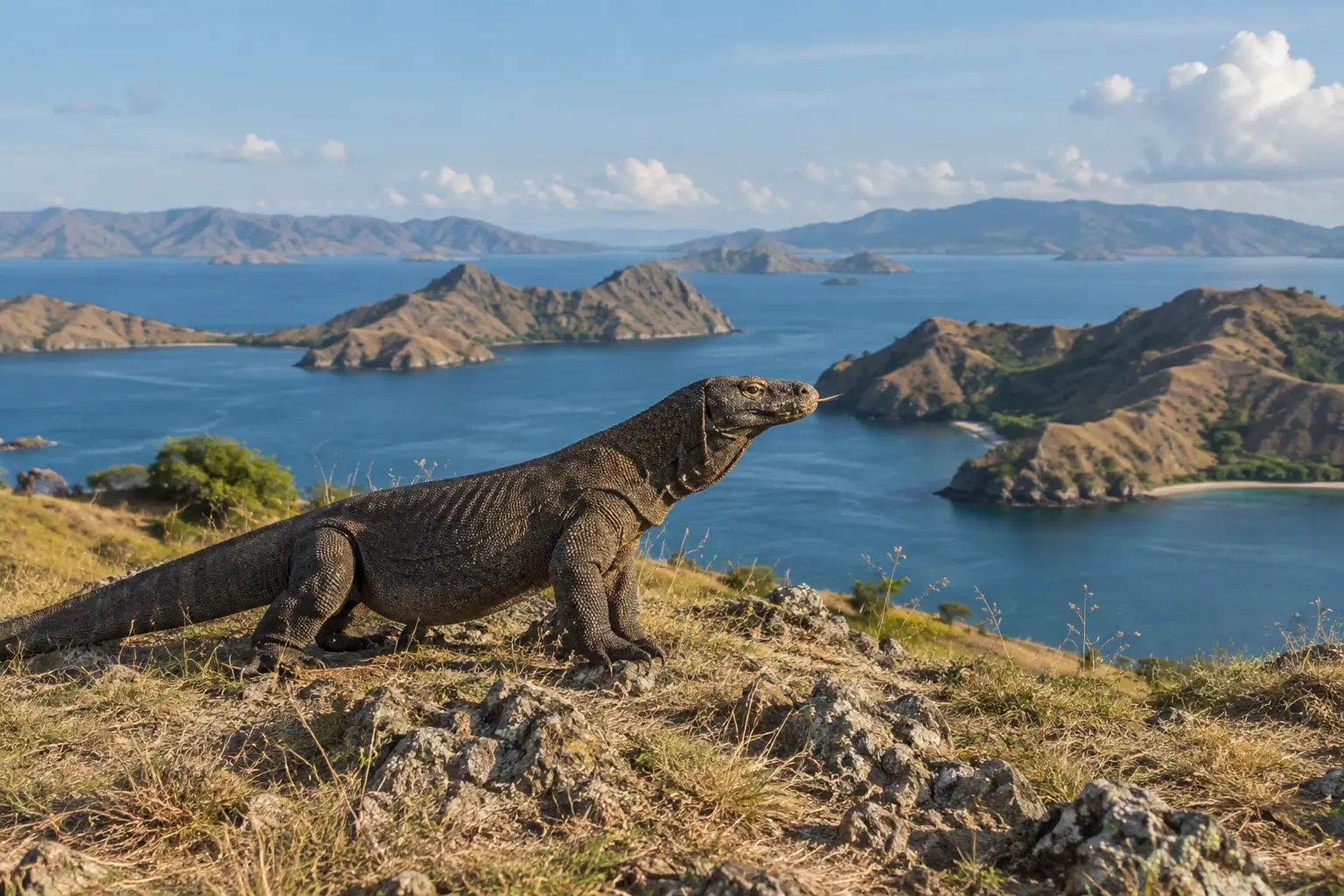
In 2019, researchers published the first full genome of the Komodo dragon. It pointed to adaptations that set monitor lizards apart from most other lizards: changes linked to heart and energy metabolism that support unusually high aerobic capacity, and a large family of genes for chemical sensing, the system behind the dragon’s constant tongue-flicking. Both fit an active predator that tracks prey and carcasses by scent over long distances.
Why Komodo dragons survive only here
The dragon’s present range is a remnant. Fossils show the species once lived more widely across the region, and the 2009 study found that its populations contracted severely within the last 2,000 years. Today wild dragons survive on Komodo, Rinca, Gili Motang and Nusa Kode inside the national park, and in parts of western and northern Flores. The 2017 count by the park authority put the park population at 2,762, with most on Rinca and Komodo.
Modern dragons also barely move between populations. Long-term tracking shows most dragons spend their lives in the valley where they hatched, and populations on the small islands are more exposed to chance events. Our behaviour guide explains that home-loving streak, and the reproduction guide covers why populations recover slowly.
Are Komodo dragons prehistoric?
In a loose sense, yes: the lineage is millions of years old, and dragons on Flores have looked much the same for nearly a million years. But they are not dinosaurs and not living fossils. Komodo dragons are lizards, part of the same broad reptile group as snakes, and they evolved long after the non-bird dinosaurs disappeared. Their serrated, iron-reinforced teeth do resemble those of some meat-eating dinosaurs, which is why palaeontologists study them.
Seeing the story in Komodo National Park
A ranger-led trek will not show you fossils, but it does show the survivors of a lineage that crossed from Australia and outlasted every other giant monitor. The komodo one day tour and the Komodo Tour 2 Days 1 Night both include treks on Rinca and Komodo Island. Our Komodo dragon facts and Rinca Island guide help you plan the visit.
Frequently asked questions
Where did Komodo dragons come from?
Fossil evidence indicates the lineage evolved in Australia around 3 to 4 million years ago and spread west through the islands, reaching Flores by about 900,000 years ago.
How old is the Komodo dragon species?
The lineage dates back roughly 3.8 million years in Australia, and dragons have lived on Flores with little change in body size for about 900,000 years.
Are Komodo dragons descended from dinosaurs?
No. Komodo dragons are lizards, related to snakes and other lizards, not to dinosaurs. Their teeth are similar in shape to those of some meat-eating dinosaurs, but the two groups are not closely related.
Did Komodo dragons evolve their size through island gigantism?
The 2009 fossil study rejected that idea. The lineage was already a giant in Australia before it reached the Indonesian islands.
What was Megalania?
A giant Australian monitor lizard, estimated at around five metres or more, that lived alongside the Komodo dragon lineage and later went extinct.
Why do Komodo dragons live only in Indonesia today?
Their range once extended more widely, but populations contracted severely within the last 2,000 years. They now survive on Komodo, Rinca, Gili Motang, Nusa Kode and parts of Flores.
Treat a fossil date as a minimum supported occurrence
A fossil assigned to a species at a dated locality supports its presence within the dating and identification limits. It does not by itself establish the exact year the lineage arrived or the route every ancestor took. Keep fossil occurrence, inferred ancestry and present distribution as separate claims.
Likewise, genomic similarity can inform relationships without turning a modern population into a living dinosaur. A helpful timeline labels the source of each step and the uncertainty between steps, instead of presenting a continuous journey that the fossil record has not preserved.
For the fossil evidence and its interpretation, see Hocknull and colleagues’ 2009 palaeobiogeography paper.
