
What Do Komodo Dragons Eat? From Geckos to Water Buffalo
What Komodo dragons eat from hatchling to adult, how they hunt and scavenge, how much one meal can be and why visitors must never feed them.
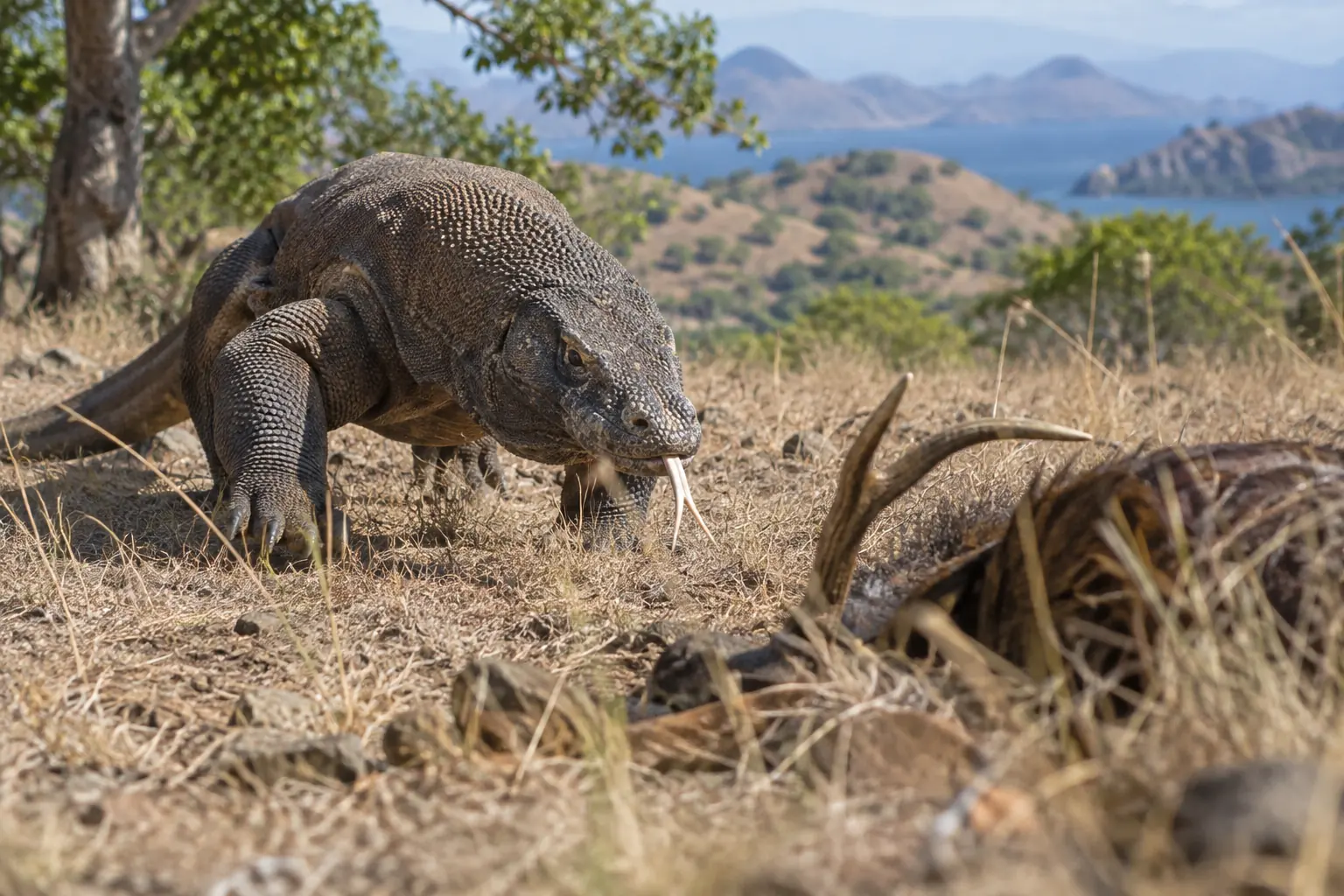
Komodo dragons are carnivores that eat almost any animal they can catch or find dead. Young dragons live in trees and eat insects, geckos, birds and eggs; adults switch to large prey, mainly Timor deer, wild pigs and water buffalo, and scavenge carcasses. A big adult can eat up to 80% of its own body weight in a single meal and then go a long time before hunting again.
What Komodo dragons eat changes more over a lifetime than for almost any other predator. A hatchling small enough to hide in a tree lives on grasshoppers; the same animal, decades later, can bring down a deer or a water buffalo far heavier than itself. This guide follows that diet from hatchling to adult, explains how dragons hunt and scavenge, and covers what it means for a visit to Komodo National Park.
Checked 24 September 2026 against the research and zoo sources listed at the end of this guide.
Komodo dragon diet at a glance
| Life stage | Typical food | Where they feed |
|---|---|---|
| Hatchlings (first months) | Grasshoppers, beetles and other insects, geckos, small lizards | In trees, away from adult dragons |
| Juveniles | Birds, eggs, rodents, snakes and larger lizards | Trees and ground |
| Larger dragons (the study discusses a transition around 18 kg; age varies) | Timor deer, wild pigs, water buffalo, goats, monkeys and carrion | On the ground, along game trails and at carcasses |
The switch from small prey to large mammals is gradual, but researchers tracking wild dragons found a clear dietary transition at around 18 kg. Below that weight dragons eat small, abundant animals; above it they go after widely scattered adult deer, pigs and buffalo, and their movements change to match.
What adult Komodo dragons eat
Timor deer are the staple. Smithsonian’s National Zoo calls deer the most popular meal, and field studies inside the park treat deer density as the best measure of how much food an island offers large dragons. Wild pigs and water buffalo are the other big prey, along with goats, monkeys and rodents where they occur.
Prey availability differs sharply between islands. Wild pigs and water buffalo live only on Komodo and Rinca, the two large islands of the park. Gili Motang and Nusa Kode have neither, and far fewer deer, and their dragons are much smaller as a result; our Komodo dragon size guide explains that link in detail.
Adults also eat snakes, birds and fish washed up on the shore, and they are cannibals. Large dragons will kill and eat smaller ones, which is the main reason young dragons spend their first years off the ground.
What Komodo dragons eat on different islands
Prey is not the same across the park, and it shapes the dragons themselves. On Komodo and Rinca, the two large islands, adult dragons can hunt Timor deer, wild pigs and water buffalo. The small islands of Gili Motang and Nusa Kode have deer but no pigs or buffalo, and far fewer deer: a survey of deer droppings found about 5.9 pellet groups per transect on Gili Motang against 20.7 on Komodo.
| Island | Large prey available | Average dragon weight (all ages) |
|---|---|---|
| Komodo | Timor deer, wild pigs, water buffalo | 23.5 kg |
| Rinca | Timor deer, wild pigs, water buffalo | 20.9 kg |
| Nusa Kode | Timor deer only | 10.8 kg |
| Gili Motang | Timor deer only, at low density | 7.9 kg |
The result is visible in the dragons. The biggest Gili Motang dragons weigh roughly a fifth as much as the biggest on Komodo, and researchers found that maximum dragon size tracked deer numbers almost perfectly. Our Komodo dragon size guide sets out the island-by-island measurements.
What young Komodo dragons eat
Hatchlings emerge around April or May and climb straight into the trees. There they eat whatever fits in their mouths: grasshoppers, beetles, geckos, small lizards and eggs. Living off the ground keeps them away from adult dragons, which are too heavy to follow them into the branches.

As juveniles grow they add birds, rodents and snakes, and spend more time on the ground. Smithsonian’s National Zoo notes that dragons that survive to around five years old move on to larger prey such as rodents, monkeys, goats, wild boar and deer.
How Komodo dragons hunt
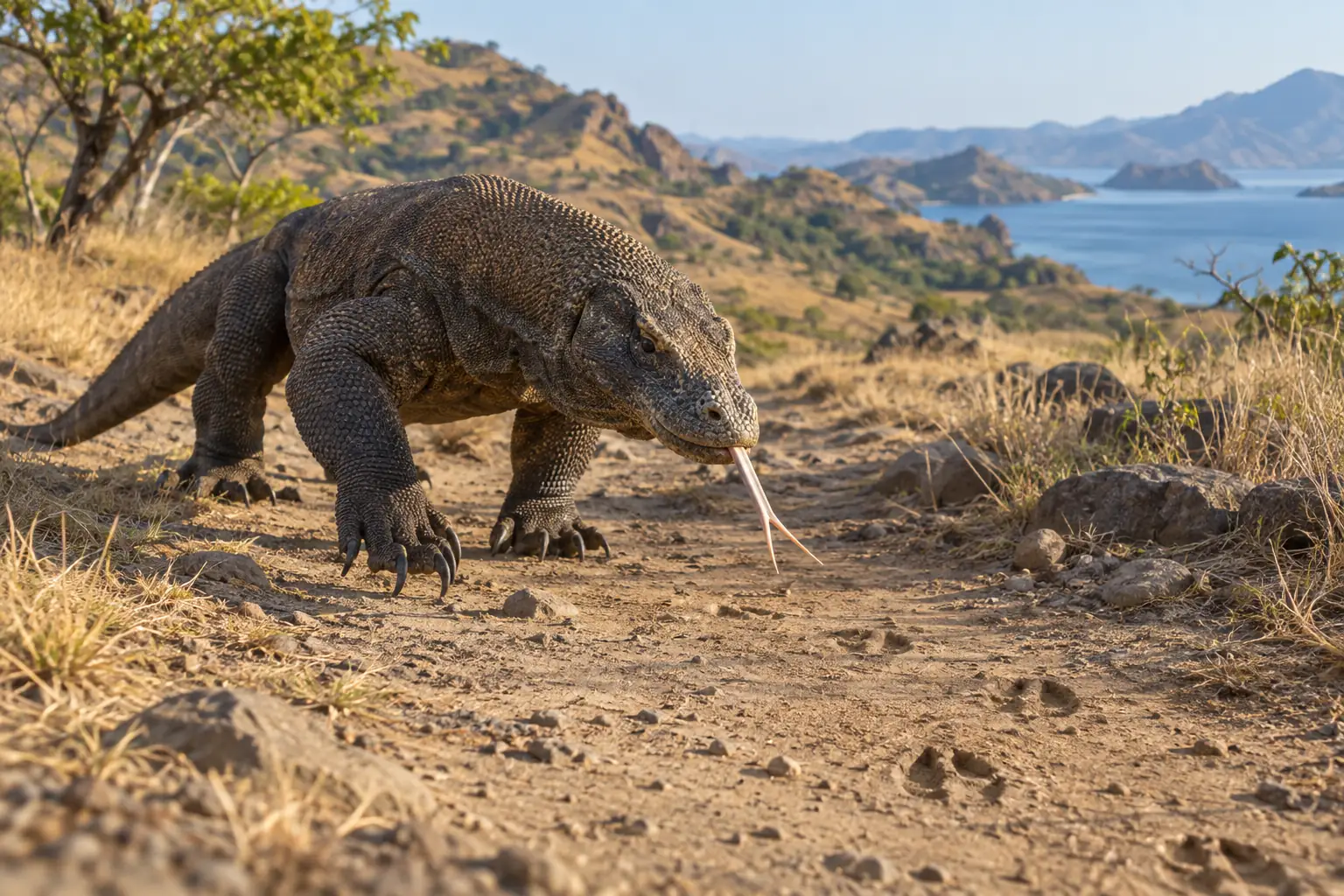
Adult dragons are mainly ambush hunters. A large dragon lies still beside a game trail, often for hours, and rushes a deer or pig that passes within reach. Smaller dragons forage more actively, covering ground in search of prey, while big adults rely on waiting.
The attack itself is a bite followed by a hard pull. Serrated, backward-curving teeth slice deep wounds, and venom from glands in the lower jaw stops the blood from clotting and lowers blood pressure, sending the animal into shock. Prey that escapes the first attack often weakens and collapses later, and the dragon, or another one, follows the scent. Our guide to Komodo dragon venom explains how the bite works.
Smell does most of the tracking. A dragon flicks its forked tongue to collect scent particles from the air and presses them against a sensory organ in the roof of its mouth; a stronger signal on one tip of the tongue tells it which direction the prey or carcass lies in.
Scavenging: why carcasses matter
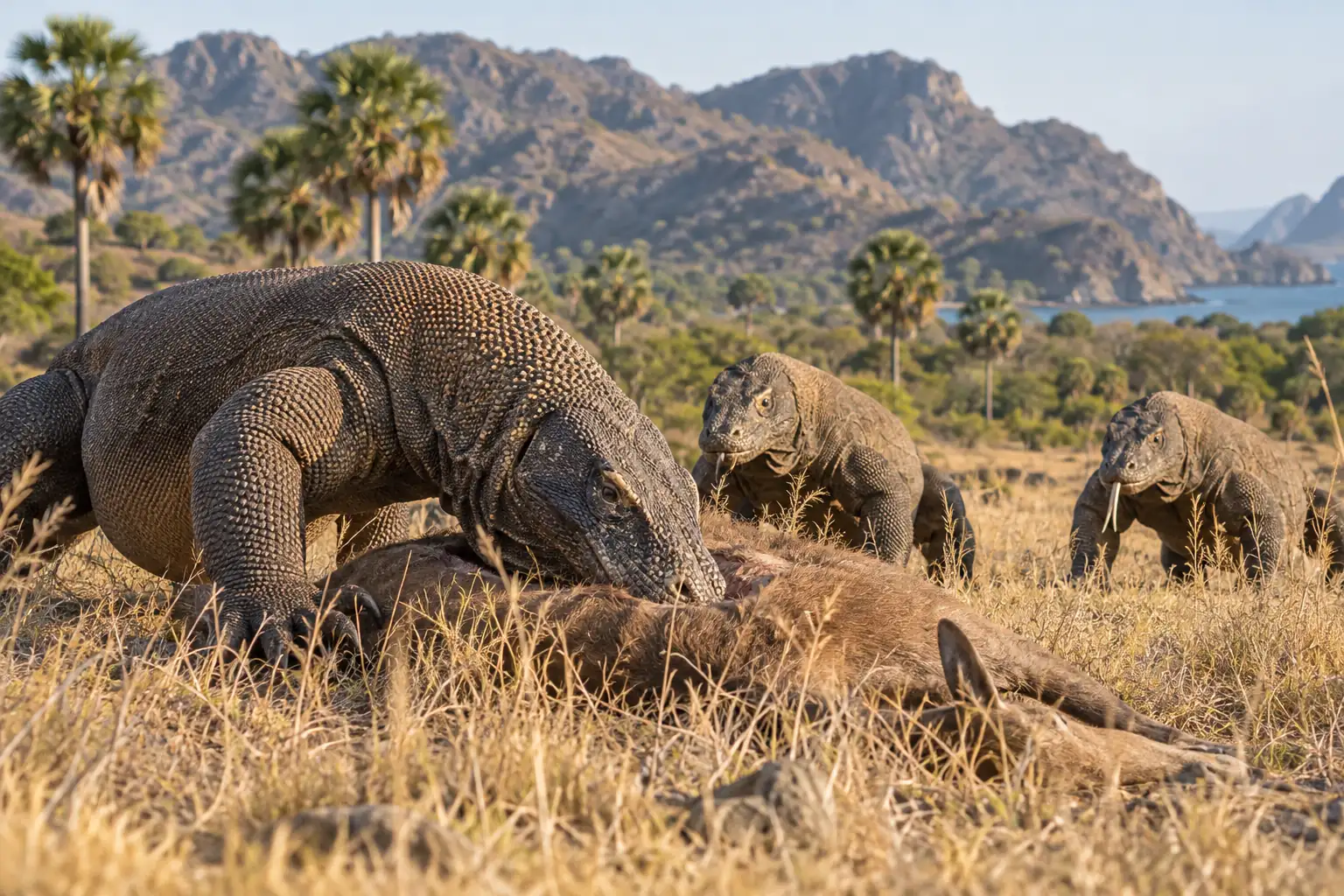
Carrion is a major part of an adult dragon’s diet, not an afterthought. Dragons pick up the smell of a carcass from a long way off, depending on the wind, and several unrelated dragons often feed on the same large carcass. The biggest animals usually eat first.
This mix of hunting and scavenging is efficient. Dragons can swallow huge chunks of meat, helped by flexible jaw joints and powerful throat muscles, and little of a carcass is wasted.
How much and how often do Komodo dragons eat?
A dragon’s stomach stretches enough to hold up to 80% of its own body weight in one meal. After a big feed it rests and digests, and it does not need to hunt again for some time. When threatened, a dragon can vomit its stomach contents to lighten itself and escape.
That low-energy lifestyle has a surprising effect on the whole ecosystem. A 2020 study compared Komodo dragons with apex mammal predators in Africa, Asia and North America. Dragons reached population biomass densities 5.75 to 231.82 times higher than those predators, yet did not control the numbers of their deer and pig prey. The researchers put this down to the dragon’s low metabolic rate and its infrequent, often inactive hunting, including heavy reliance on scavenging.
Feeding rules for visitors
Feeding dragons is not allowed, and there is good reason. A 2018 study found that dragons around busy visitor areas were heavier, in better condition and less wary than dragons elsewhere, which the authors linked to food scraps and other human-provided food. They recommended removing these food subsidies altogether.
- Never feed or bait a dragon, even for a photo.
- Keep food and rubbish on the boat, not in your daypack on the trail.
- Follow the ranger’s distance instructions; a dragon that has learned to associate people with food is more dangerous, not less.
Where to see Komodo dragons in the wild
Most treks show dragons resting or basking rather than hunting; seeing a kill is rare luck. Your best chance of watching dragons active is early in the morning on a ranger-led walk at Loh Buaya on Rinca or Loh Liang on Komodo Island. When comparing Komodo tour packages, confirm the named ranger gateway and route; a tour duration does not guarantee both Komodo and Rinca. Our Rinca Island guide and Komodo Island vs Rinca comparison help you plan the trek, and the Komodo dragon facts guide covers the rest of their biology.
Frequently asked questions
What do Komodo dragons eat in the wild?
Adults eat mainly Timor deer, wild pigs and water buffalo, plus goats, monkeys, rodents, snakes, birds and carrion. Young dragons eat insects, geckos, small lizards, birds and eggs.
What do baby Komodo dragons eat?
Hatchlings live in trees and eat grasshoppers, beetles, geckos, small lizards and eggs. Staying off the ground keeps them away from adult dragons.
Do Komodo dragons eat other Komodo dragons?
Yes. Large dragons kill and eat smaller ones, which is why juveniles spend their early years in trees.
How much can a Komodo dragon eat at once?
Up to about 80% of its own body weight in a single meal. It then rests while it digests and can go a long time before hunting again.
Do Komodo dragons eat water buffalo?
Yes, on Komodo and Rinca, the only islands in the park where water buffalo live. A buffalo is far heavier than the dragon that attacks it.
Do Komodo dragons eat people?
People are not normal prey. Attacks are rare but have happened, which is why every visit to dragon habitat is led by a park ranger.
Do Komodo dragons eat plants?
No. Komodo dragons are carnivores; any plant material they swallow comes with their prey.
Read prey and body size at the study scale
A diet study can describe a size-related shift without supplying one birthday on which every dragon changes food. Body mass, prey availability and the sampled population matter. Keep a reported transition around a body-mass range separate from a universal age threshold.
An island table of sampled animals can include juveniles and adults. Its average mass is not an adult-weight recommendation or proof that diet alone caused every size difference. Use the original study’s sample and methods when interpreting the relationship, and never feed wildlife to test it.
For the research behind size-related dietary change, see the 2016 ontogeny study; it does not establish one transition age for every individual.
Compare the komodo tour 3 days 2 nights format, then confirm the actual vessel, route, permissions and services with its operator.
