
Reef Manta vs Oceanic Manta: A Komodo ID Guide
How divers and snorkellers can distinguish reef and oceanic manta rays without competing with the Manta Point destination guide.

Reef manta rays (Mobula alfredi) and oceanic manta rays (Mobula birostris) can overlap in tropical waters. Oceanic mantas are generally larger and may show a caudal spine or knob, while reef mantas are more closely associated with coastal cleaning and feeding areas. Size alone is not enough. Photograph the underside, dorsal shoulder pattern and tail area without chasing the animal.
Why the Identification Is Easy to Get Wrong
A large manta passing over a snorkeller feels enormous regardless of species. Perspective, camera lens and distance exaggerate size, while dark water hides the markings used for identification. That is why “it looked bigger” is weak evidence.
The two species compared here share the same wing-like body plan and can occur in the same broad region. A useful identification combines proportions, dorsal markings, the tail area, underside spotting and behaviour.
This guide compares manta identification features. For access, current and visitor logistics, use the Manta Point guide. Our Komodo diving guide covers broader trip planning.
Reef Manta vs Oceanic Manta
| Feature | Reef manta ray | Oceanic manta ray |
|---|---|---|
| Scientific name | Mobula alfredi | Mobula birostris |
| Relative size | Generally the smaller species | Generally grows larger |
| Typical range | More associated with coastal and reef systems | More wide-ranging and oceanic |
| Dorsal shoulder pattern | Pale markings often form a softer, curved or Y-like pattern | White shoulder patches tend to appear more angular |
| Tail area | No functional spine | May show a vestigial caudal spine or knob |
| Underbelly spots | Unique individual pattern, often extending through the belly | Unique individual pattern; distribution can help specialists |
None of those features should be used alone from a poor image. When key areas are hidden, record the animal simply as a manta ray.

What the Dorsal Pattern Can Tell You
Viewed from above, both species may appear black with pale shoulder markings. Reef mantas often show pale areas that sweep back in a softer curve, while oceanic mantas tend to show more sharply angled white patches. Melanistic individuals complicate the comparison because their upper surface can be almost entirely dark.
Lighting and water colour also alter contrast. Keep an unedited original image when requesting identification.
The Underbelly Is an Individual Fingerprint
Every manta has a distinctive arrangement of dark spots on the ventral surface. Researchers use clear underside photographs to recognise individuals, document resightings and study movement. The image is most useful when it includes the area between the gill slits and farther back toward the abdomen.
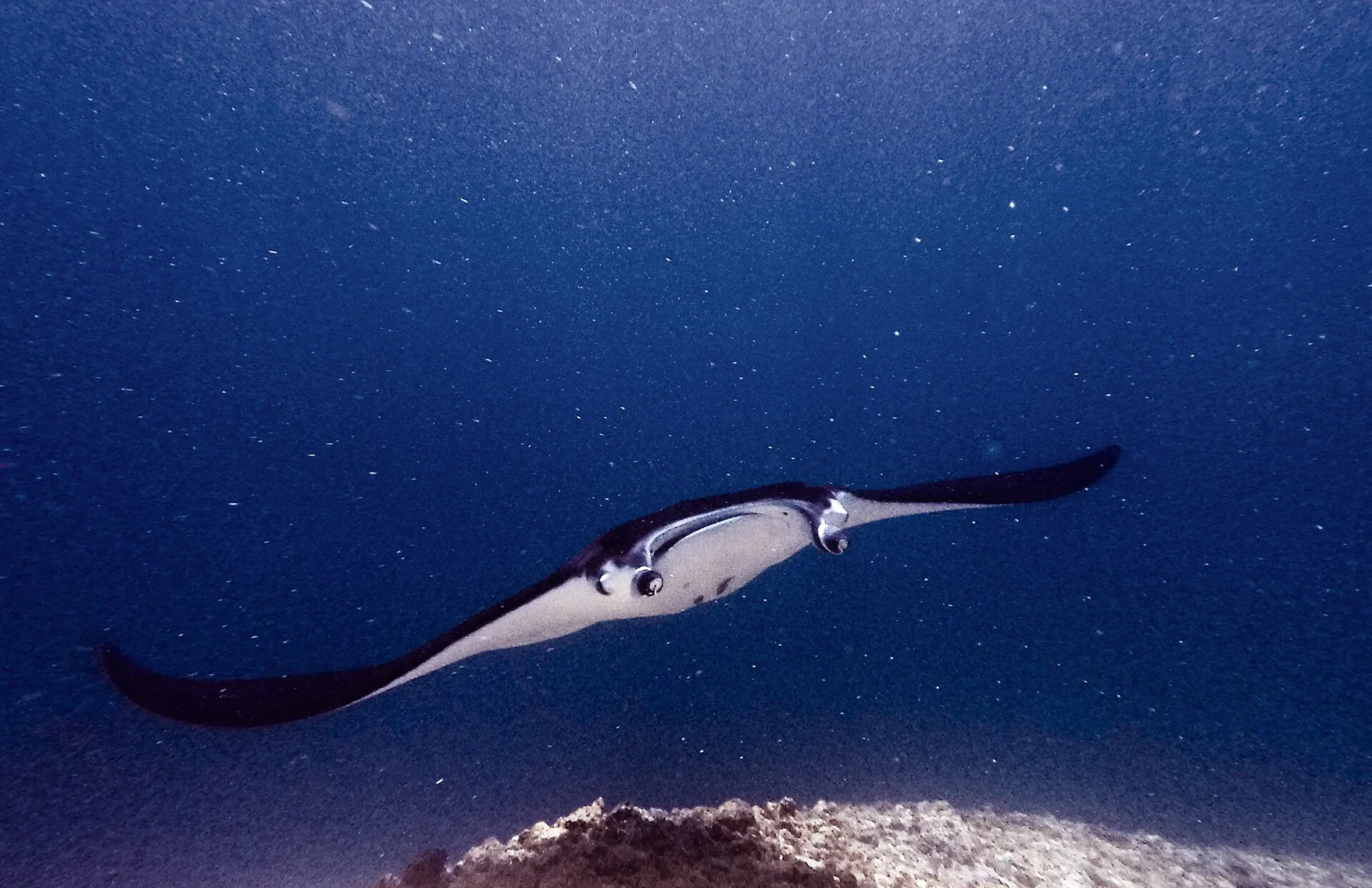
Do not swim underneath or block a manta to obtain the photograph. If the animal passes naturally overhead, hold position and take the frame. An ethical photograph has value precisely because it records normal behaviour.
Chevron and Melanistic Colour Morphs
Both manta species can occur in a common chevron pattern or a much darker melanistic form. A melanistic manta may have an almost black dorsal surface and a dark underside broken by patches and spots. Colour morph is not the same thing as species.
This matters in Komodo because a dark animal can appear larger and more oceanic in low visibility. Identification still needs the shoulder, tail and ventral pattern rather than an impression of darkness.
Can You Tell Male and Female Mantas Apart?
Mature males have a pair of claspers along the inner pelvic fins near the base of the tail. Females do not. The feature is visible from below when the animal passes naturally overhead, but it should never motivate a pursuit.
Juveniles and distant animals can be difficult to sex from a photograph. Record “unknown” when the relevant area is hidden.
Building a Useful Photo-ID Record
- Keep the original image at full resolution.
- Record date, site and approximate time.
- Note cleaning, feeding, courting or travelling behaviour.
- Include the underside between the gills and tail base when naturally possible.
- Do not over-edit spot contrast or remove scars.
- Submit through a recognised regional research or photo-ID programme.
Scars, Injuries and Fishing Line
Scars can help distinguish individuals, but they also document interactions with fishing gear, boats or predators. If an animal appears entangled, alert the guide and appropriate conservation team. An untrained swimmer should not attempt to grab a moving manta.
Cleaning, Feeding or Travelling?
Cleaning
A manta may circle or hold over a coral feature while cleaner fish remove parasites. Divers should remain outside the cleaning structure and avoid occupying the animal’s approach path.
Feeding
Feeding mantas may swim with open mouths through plankton-rich water, sometimes changing direction repeatedly. Snorkellers should avoid cutting across the feeding line.
Travelling
A manta moving steadily through the area may make one pass and disappear. Chasing it rarely extends the encounter and can separate a swimmer from the group.
Which Manta Is Seen in Komodo?
Reef mantas are strongly associated with Komodo’s coastal cleaning and feeding areas. Oceanic mantas can also occur, but should not be claimed from size alone. A species-level record needs adequate visual evidence or expert review. The guide to Manta Point conditions and encounters explains the access and current questions at Karang Makassar.
Komodo is valuable because repeated photo identification can reveal which individuals return and how they move. A visitor can contribute a clean underside image and accurate date/location without claiming more than the evidence shows.
Responsible Manta Positioning
- Enter quietly and follow the guide’s approach line.
- Stay low or to the side when instructed; do not surround the cleaning station.
- Never touch, ride or intercept a manta.
- Do not chase a departing animal.
- Keep enough awareness for current, boats and the rest of the group.
Photography Checklist
- Use wide-angle framing rather than closing the distance.
- Capture underside spots, dorsal shoulders and tail area when naturally visible.
- Record date, site and behaviour.
- Keep the original file for identification.
- Submit useful images to an appropriate research database when requested.
Choosing a Manta-Focused Trip
Ask how the operator manages cleaning-station traffic, chooses tidal windows and separates divers from snorkellers. Several suitable encounters are more realistic than a single fixed promise.
Compare published vessels on the Komodo diving trips page. For general sightseeing and snorkelling formats, the Komodo Island Tour packages hub covers the main route options.
Mantas are part of a wider reef ecosystem. Observe behaviour and habitat without chasing an animal or turning an identification attempt into a close approach.
If the underside, shoulder pattern and tail area are not visible, label the animal “manta ray” rather than forcing a species identification.
Taxonomy update: the comparison is not a global species count
Reef manta versus oceanic manta remains a useful comparison for an Indo-Pacific trip, but it is no longer correct to say there are only two recognised manta species worldwide. The Atlantic manta ray, Mobula yarae, was formally described in 2025. Manta Trust now treats it as a separate species.
This update does not add an Atlantic species to a Komodo checklist. It changes the global taxonomy and shows why a comparison article needs a geographic boundary. Here the focal species remain Mobula alfredi and Mobula birostris; a claim about either animal at a specific Komodo site still needs an identifiable local record.
Species identification and individual identification must also stay separate. The first asks which species the animal belongs to, using several anatomical and colour-pattern features. The second compares a ventral spot pattern against an existing catalogue to see whether the same individual was photographed before. An attractive belly image may support the second task without resolving every species-level feature.
When reviewing your photographs, record the features you can actually see and leave missing ones blank. Do not estimate an exact wingspan without a reliable scale, and do not interpret proximity to shore as proof of reef-manta identity. If the evidence conflicts, a broad “manta ray” label is a useful and honest observation.
Manta Trust: Atlantic manta ray taxonomy.
Match the wildlife interest to your trip
Use the dive komodo listing to compare dedicated diving options, then confirm the route, recent habitat observations and guide arrangements with the operator. Wildlife and daily site access remain conditional.
Frequently Asked Questions
Is every very large manta an oceanic manta?
No. Perspective is unreliable, and large reef mantas can appear enormous. Use several diagnostic features.
Do manta rays have stingers?
Mantas do not have the functional stinging barb associated with stingrays. Oceanic mantas may retain a vestigial caudal spine or knob.
Why photograph the belly?
The ventral spot pattern is unique to the individual and can support photo-identification research.
Are mantas guaranteed at Manta Point?
No. The location provides suitable habitat and repeated encounters, but tide, plankton and animal behaviour remain variable.
