
Why Is Komodo Marine Life So Diverse? Currents and Habitats
Learn why Komodo supports diverse marine life through water movement, habitat connections and ecological variety, without misleading species counts.
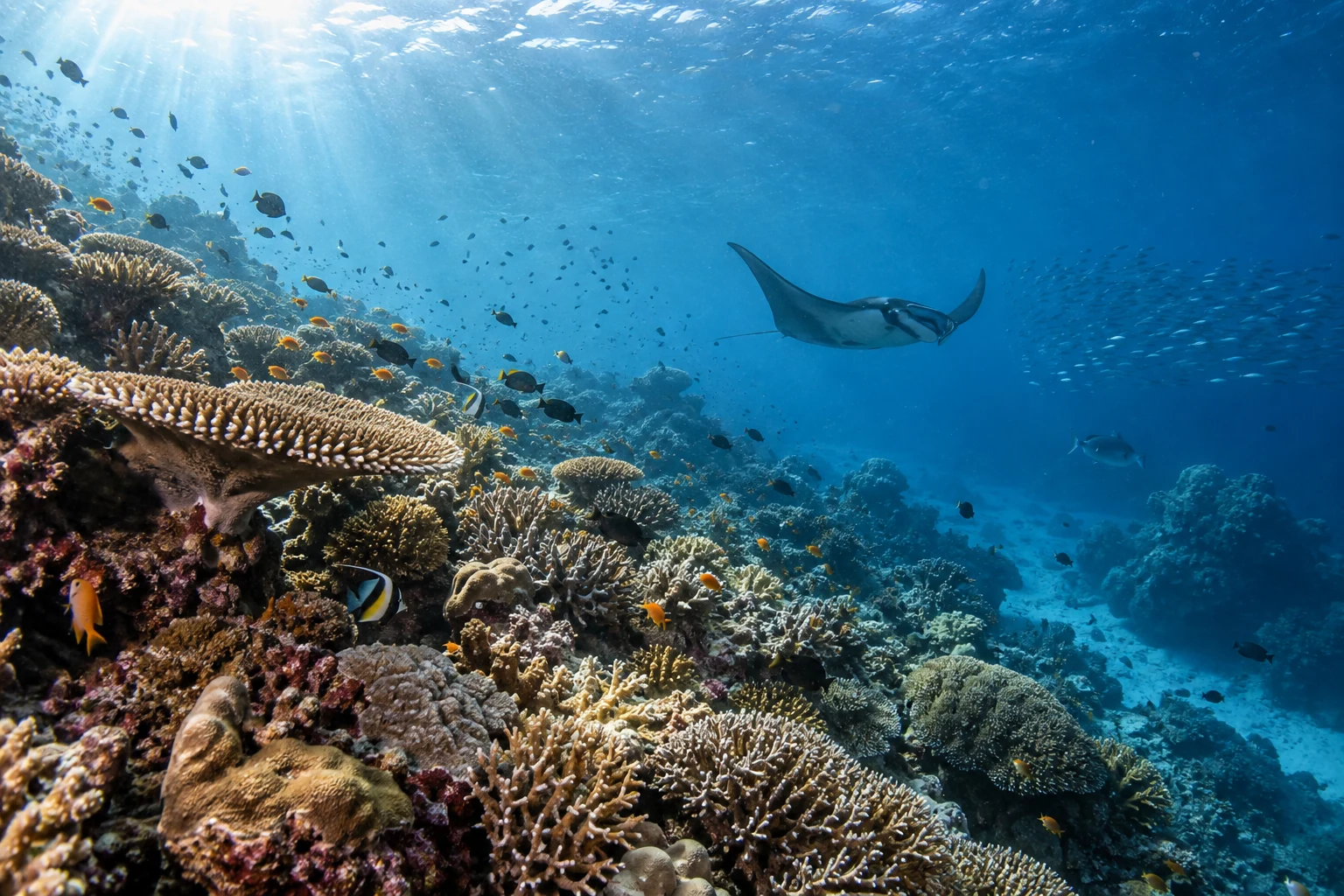
Komodo’s marine diversity reflects a combination of geography, water movement and connected habitats. Tides move water through channels, exposure and depth create different conditions, and reefs, seagrass and mangroves offer different resources. No single current, season or species count explains the whole system.
This article explains the environmental processes behind Komodo’s biodiversity. For a habitat-by-habitat overview of species visitors may encounter, continue to marine life in Komodo.
Start with geography, without the “only place” claim
Komodo lies within the Indonesian archipelago between larger ocean basins. Narrow passages, island slopes and deeper surrounding water influence how water moves locally. It is misleading to call it the only place where the Indian and Pacific oceans meet: Indonesian ocean connections are much broader than one national park.
UNESCO’s description of the property emphasises the combination of marine habitats and nutrient-rich water exchange. That explains why the park can support diverse communities within a relatively compact island landscape. It does not mean every reef experiences the same conditions.
Three different ideas are often called “the current”
| Process | Useful scale | Visitor implication |
|---|---|---|
| Regional circulation | Movement between ocean basins and through the archipelago | Sets part of the wider oceanographic context |
| Tidal flow | Changing movement around channels and reef features | The same site can behave differently within a day |
| Local mixing or upwelling | Water brought between depths or mixed around topography | Temperature, nutrients and visibility can change locally |
These processes can interact, but they should not be treated as interchangeable. A strong flow felt by a diver is not a measurement of nutrient supply. Nor does one cold dive prove an upwelling pattern across the entire park.
Nutrients do not mean that more is always better
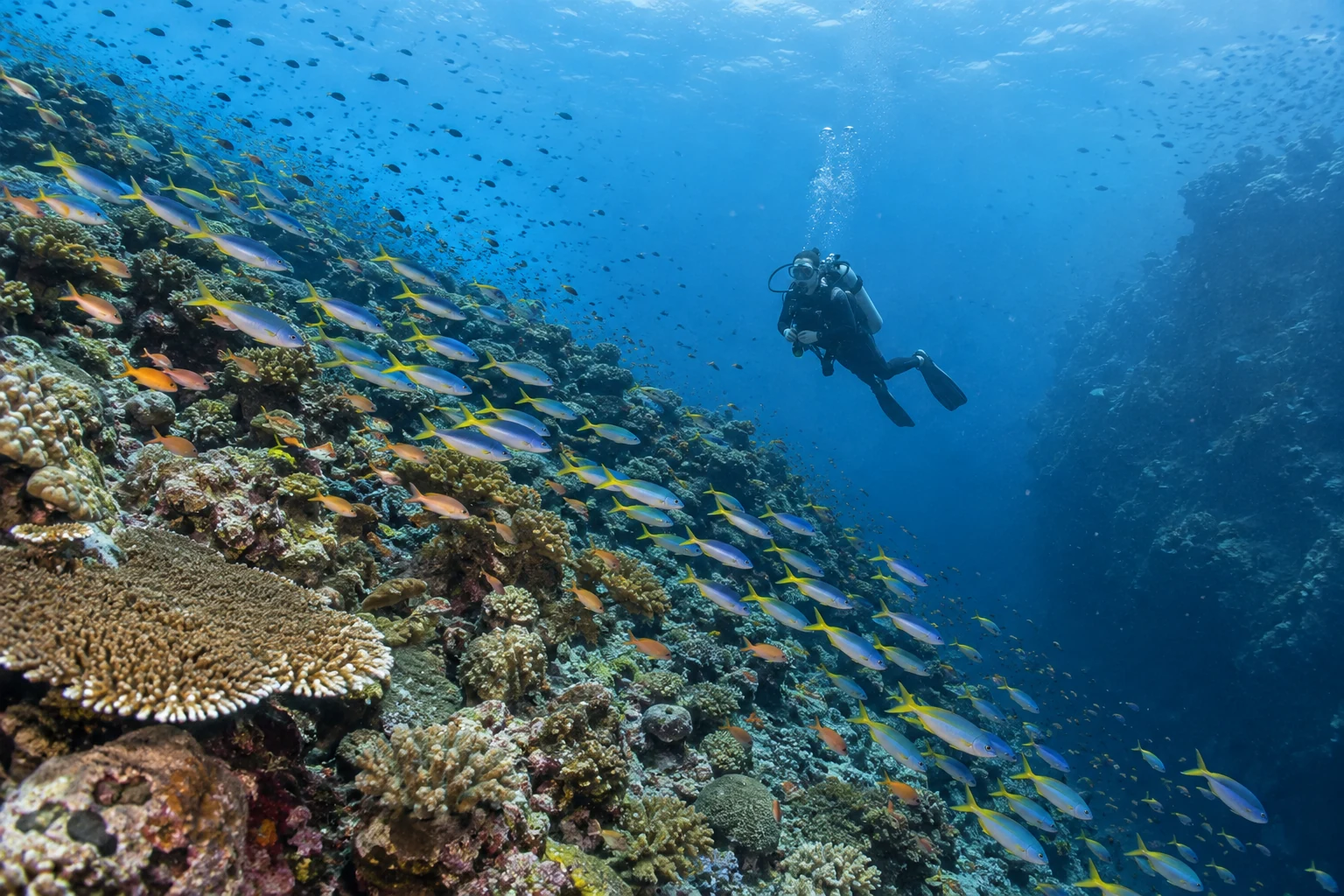
Food availability can support plankton and the animals feeding on it. At the same time, many reef-building corals depend on adequate light and suitable water quality. Excess sediment or pollution is not beneficial merely because a tourism article describes the region as nutrient-rich.
Distinguish natural water exchange from runoff or waste input. They differ in composition, concentration and timing. A mechanism that supports one part of the food web can affect another organism differently.
A habitat mosaic creates more ways to live
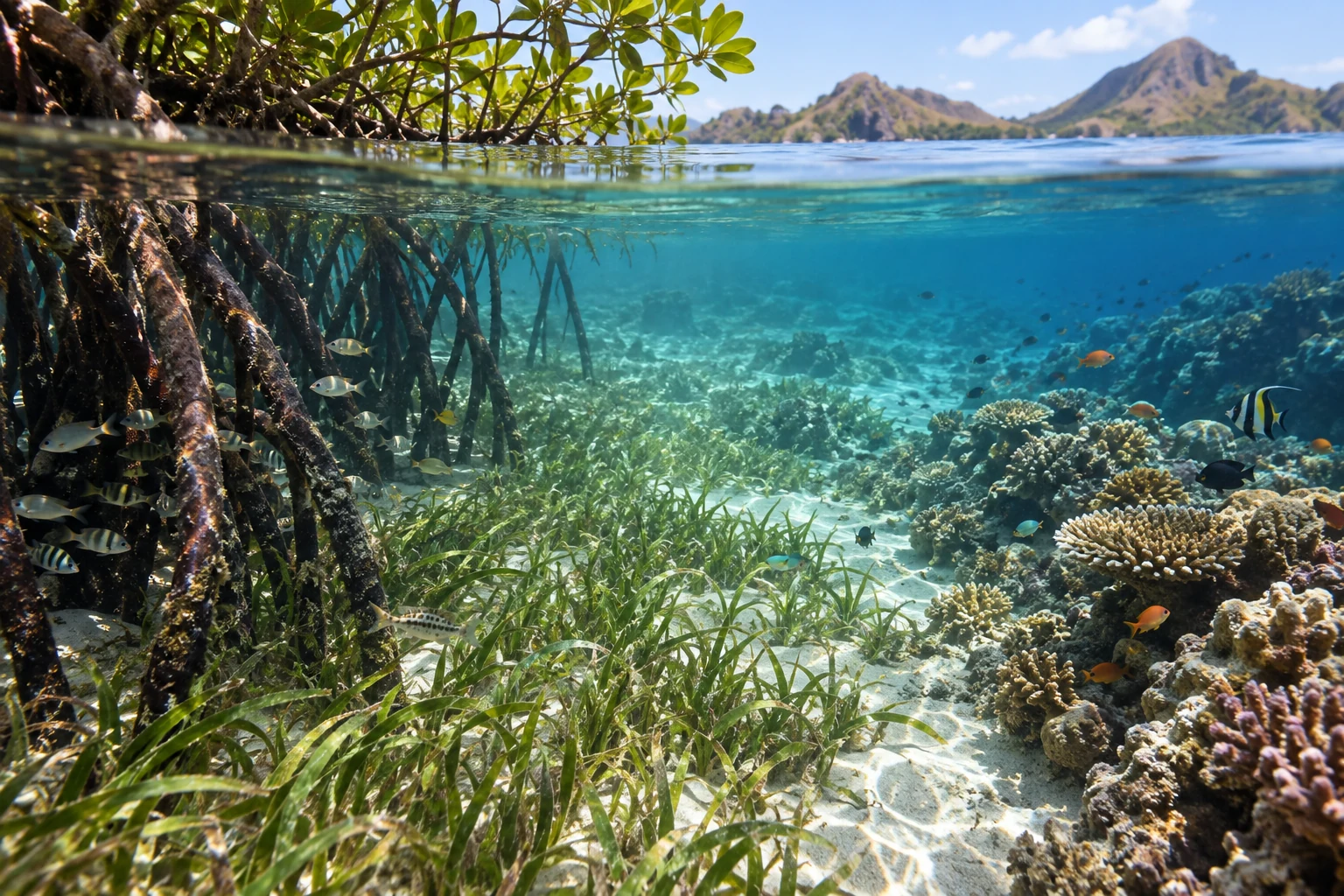
A coral slope offers different shelter from a sandy burrow field. Seagrass leaves and sediments offer a different environment from mangrove roots. A gorgonian fan presents a specialised host surface for animals such as pygmy seahorses, while open water above a reef supports another set of interactions.
The WCS account of Komodo’s 2008 seagrass work describes meadows between mangrove margins and reefs. That is a documented example of connected habitats. Protecting only a famous dive pinnacle would miss part of the coastal system that makes the destination ecologically interesting.
Diversity is not the same as abundance
Species richness asks how many species occur within a defined area or sample. Abundance asks how many individuals are present. A reef with a large school of one fish can appear busier than a site with many less conspicuous species. Neither a busy photograph nor a long tourist checklist replaces a defined survey.
Before repeating a number, ask what was counted, where, when and how. “Fish species in the park” differs from “marine species in the wider region”. A list combining fishes, corals and mammals should not be presented as a fish count.
Why famous wildlife is only part of the answer
Mantas, turtles and sharks draw attention, but the reef’s smaller organisms provide much of its structure and ecological activity. Watch grazers, cleaner fish, burrow users and animals on host organisms. A visit without a large animal can still reveal a complex, functioning habitat.
This is also why a claim that every Komodo reef is healthy is too broad. Biological richness can coexist with local damage, temperature stress or fishing pressure. Condition needs repeated observations at named places.
Turn the explanation into a better trip question
Ask which habitats the itinerary visits and what the guide expects to interpret in each. A route with several genuinely different habitats may offer more learning than several stops described with the same wildlife list. Compare the dive komodo programmes, then check that the planned sites suit your abilities and current conditions.
Does stronger current guarantee more animals?
No. Stronger flow can also reduce the time or control available for observation. Site selection should balance habitat opportunity and safe conditions.
Explain a wildlife-rich stop without a guarantee
Ask what habitats a proposed stop crosses and whether the operator can alter the plan when current or visibility changes. Upwelling, tidal flow and habitat variety describe different processes; none can guarantee a particular animal on a particular day. A route with time to observe multiple habitats offers a clearer value proposition than an unsourced species tally.
Match the explanation to the scale of the evidence
Regional currents, one reef’s habitat and a traveller’s single swim describe different scales. A broad Coral Triangle explanation cannot establish the species count or visibility at a named stop on a particular day. Use surveys with dates, boundaries and methods for numerical local claims.
When planning a visit, ask about the actual habitat, recent conditions and appropriate activity. A nutrient-rich system can still have low visibility or unsuitable surface conditions. Biodiversity is a reason to observe carefully, not a promise that every famous animal appears together.
