
Komodo Dragon Reproduction: From Mating Fights to Hatchlings in the Trees
How Komodo dragons reproduce: mating season, male fights, nests in scrubfowl mounds, clutch size, incubation, hatchlings and virgin births.

Komodo dragons breed in the dry season. Males fight for females around June to August, and females lay a clutch of roughly 20 eggs, most often in the abandoned mound nest of a scrubfowl, around August and September. The eggs incubate for 7 to 8 months and hatch around April or May, when the young climb straight into the trees. Captive females have also produced young without a male, a rare process called parthenogenesis.
Komodo dragon reproduction is slow, risky and surprisingly well studied. Field teams inside Komodo National Park have tracked nests year after year, and a pair of zoo females in the United Kingdom showed in 2006 that dragons can reproduce without mating at all. This guide follows the whole cycle, from the males’ fights to the hatchlings’ first weeks in the trees, and explains what it means for your visit.
Checked 24 September 2026 against the research listed at the end of this guide.
The Komodo dragon breeding cycle at a glance
| Stage | Timing | What happens |
|---|---|---|
| Courtship and male fights | Roughly June to August | Males wrestle rivals and follow females by scent |
| Nest preparation and laying | Around August to September | Females dig egg chambers, mostly in scrubfowl mounds |
| Incubation | 7 to 8 months | Eggs develop in the warm soil through the wet season |
| Hatching | Around April or May | Hatchlings dig out and climb into trees |
| Female maturity | About 8 to 11 years | Females begin breeding and growth slows sharply |
Mating season and male fights
The breeding season falls in the middle of the dry season, roughly June to August. Males track receptive females by scent, and rival males fight for access. They rear up on their hind legs, balanced on their thick tails, and grapple with their forelimbs until one is thrown to the ground. The loser backs off, often with bite wounds that dragons seem to tolerate well.
Size matters in these contests, which is one reason males keep growing for decades while females do not. Our Komodo dragon size guide explains that difference, and the behaviour guide describes the fights in context.
Where Komodo dragons lay their eggs
Female dragons dig their egg chambers in three kinds of site. A study of nests on Komodo Island found 46 nesting sites, 26 of them active in the 2002–2003 season, concentrated in the large coastal valleys of the north of the island. The choice of site was clear:
- Scrubfowl mounds: 61% of active nests were dug into the large incubation mounds built by the orange-footed scrubfowl, a ground bird.
- Hillside nests: 19.5% were large excavations dug into slopes.
- Ground nests: 19.5% were deep, sloping burrows in flat ground.
Within the scrubfowl mounds, females picked sites partly on sunlight exposure, which affects how warm the eggs stay. The mounds are built for incubation in the first place: scrubfowl use heat from the soil and decaying leaves, not their own bodies, to warm their eggs. Dragons and wild pigs are in turn the main predators of scrubfowl eggs.
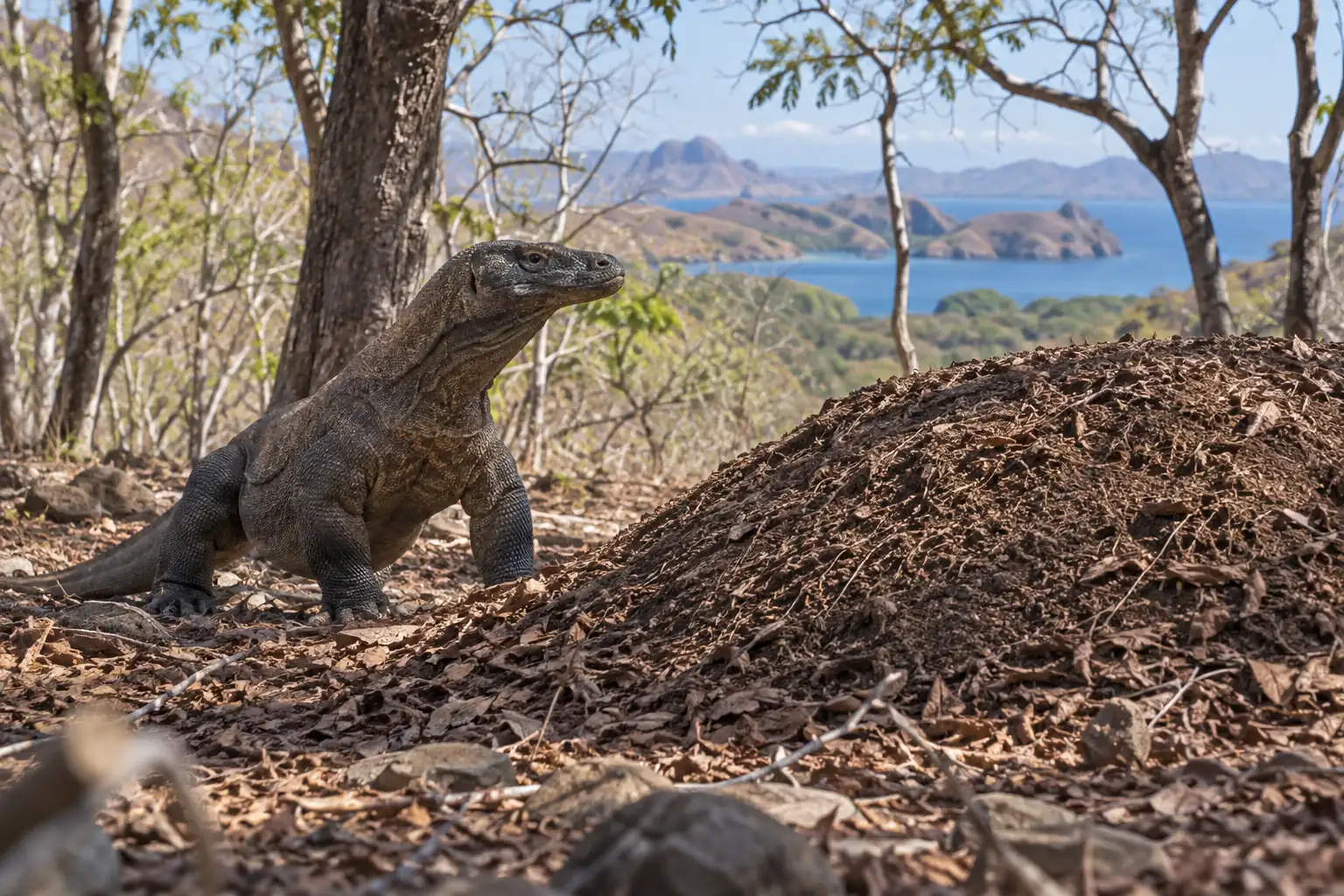
Females often dig several holes at a nest site, which is thought to help hide the chamber that actually holds the eggs. Only a small number of females nest in any one year. A 2002–2006 study in the park recorded between 6 and 16 nesting females a year across 42 potential nesting sites; most bred every year and some every other year, and nesting females were noticeably lighter than when they were not breeding.
Eggs, incubation and hatching
A clutch averages around 20 leathery eggs. There is no brooding: the eggs incubate in the warm soil for about 7 to 8 months, right through the wet season, and hatch around April or May.
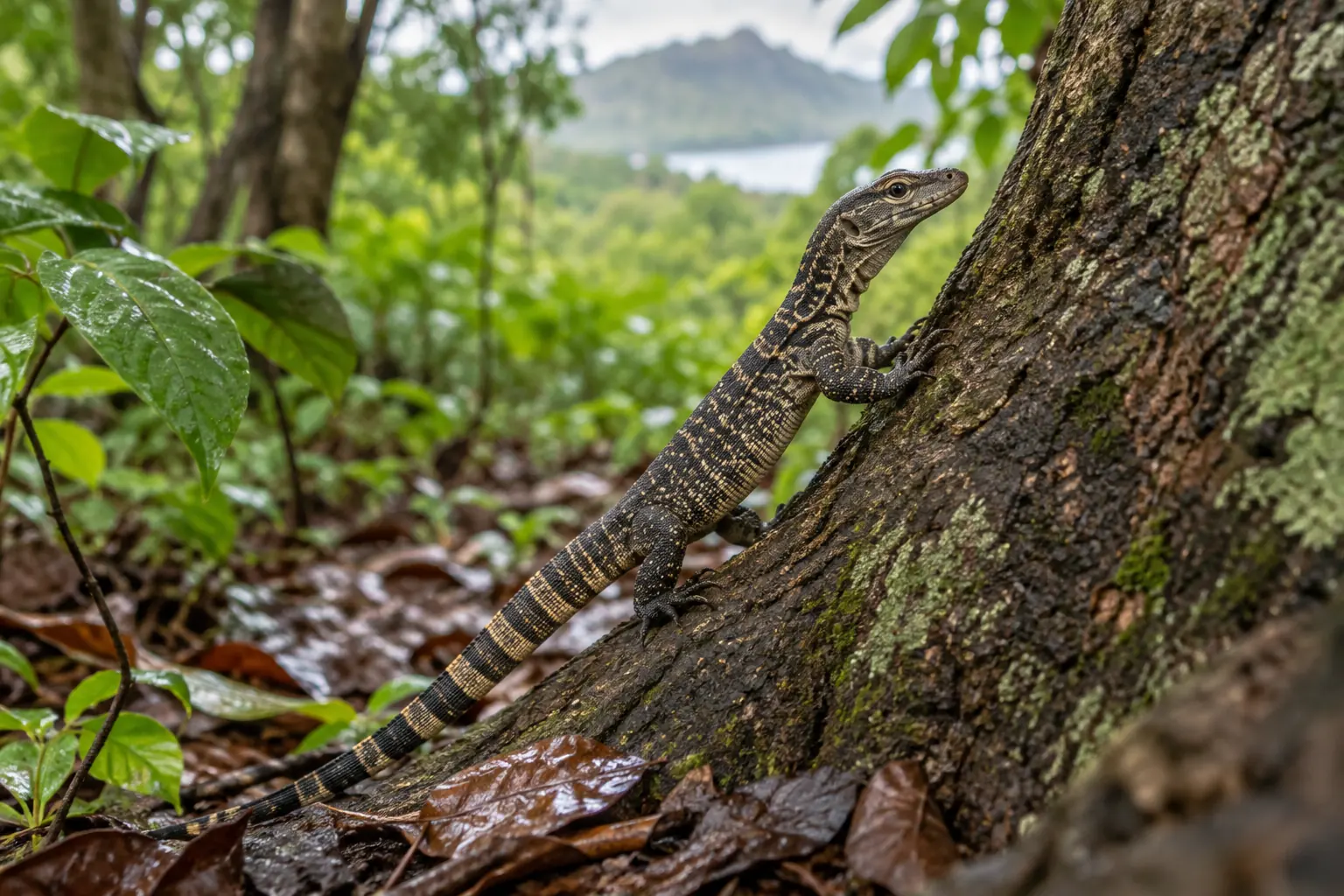
Hatchlings are roughly 30 to 45 cm long and brightly banded. They dig their way out and head for the trees almost immediately, because adult dragons, including their own species, are their main predator. They live mostly off the ground for their first years, feeding on insects, geckos and eggs; our guide to what Komodo dragons eat covers that diet. There is no parental care once the young hatch.
Can Komodo dragons reproduce without a male?
Yes, at least in captivity. In 2006, researchers reported in Nature that two female Komodo dragons in UK zoos, Flora at Chester Zoo and Sungai at London Zoo, had produced offspring without any contact with a male. Genetic tests confirmed that the young carried only their mother’s genes, a process called parthenogenesis.
All the young were male. Komodo dragons use a ZW sex-determination system, in which females carry one Z and one W chromosome. An egg that develops without fertilisation ends up with two copies of the same chromosome: ZZ, which produces a male, or WW, which does not develop. One of the two females later also bred normally with a male, showing that dragons can switch between the two modes.
The researchers suggested this ability could let a single female that reaches a new island start a population on her own, with her sons then mating with her. Parthenogenesis has not been documented in wild dragons, and in zoos it raises a practical problem, because it reduces genetic diversity in captive-breeding programmes.
Why reproduction limits the population
Several features make dragon populations slow to recover. Females take about 8 to 11 years to mature, then put almost all their energy into eggs, and a 2012 growth study never recorded a female older than about 31, compared with an estimated 60 years or more for males. That difference in lifespan skews populations towards males. Only a small number of females nest in a given year, and hatchlings face years of predation, much of it from other dragons.
This is one reason park managers protect nesting areas and why the 2017 park count put the total population at 2,762 dragons across five islands.
What visitors can see
You are unlikely to see mating or egg-laying, but you may walk past nesting areas on a trek; on Rinca, some trails wind between known nest sites, and rangers route groups around active ones. Male fights are occasionally seen in the dry season, and young dragons can sometimes be spotted in trees from April onwards.
Keep well back from any nest and follow the ranger’s route. The komodo one day tour and the Komodo Tour 2 Days 1 Night both include ranger-led treks on Rinca and Komodo Island; see the best time to visit for how the breeding calendar fits the seasons.
Frequently asked questions
When is Komodo dragon mating season?
Roughly June to August, in the middle of the dry season. Males fight rivals for access to females during this period.
How many eggs does a Komodo dragon lay?
A clutch averages around 20 eggs. Only a small number of females nest in any one year.
How long do Komodo dragon eggs take to hatch?
About 7 to 8 months. Eggs laid around August or September hatch around April or May.
Where do Komodo dragons lay their eggs?
Most often in the abandoned incubation mounds of the orange-footed scrubfowl, and otherwise in hillside or ground burrows. On Komodo Island, 61% of active nests were in scrubfowl mounds.
Can Komodo dragons reproduce without a male?
Yes, in captivity. Two UK zoo females produced young through parthenogenesis in 2006, and all the offspring were male.
Do Komodo dragons look after their young?
No. Hatchlings are independent from birth and climb into trees to avoid adult dragons, including their own species.
At what age do Komodo dragons start breeding?
Females mature at about 8 to 11 years old in the wild.
Separate a breeding observation from a population forecast
A successful nest or a photographed hatchling is a local event. It cannot establish recruitment across the species without information about survival, sampling and the period observed. Likewise, captive parthenogenesis demonstrates a reproductive mechanism without proving how often it occurs in wild populations.
For visitors, breeding and hatching accounts provide context, not a schedule for approaching nests. Follow the ranger’s permitted route and keep the location of sensitive observations discreet. Do not encourage a guide to expose a nest or move a juvenile for a photograph.
For sex, age and site differences in measured growth, see Laver and colleagues’ 2012 capture–mark–recapture study.
