
What to Pack for Komodo
A practical Komodo packing list for a hot, bright, salty trip with small cabins and no shops, separated into what is essential, useful and optional.
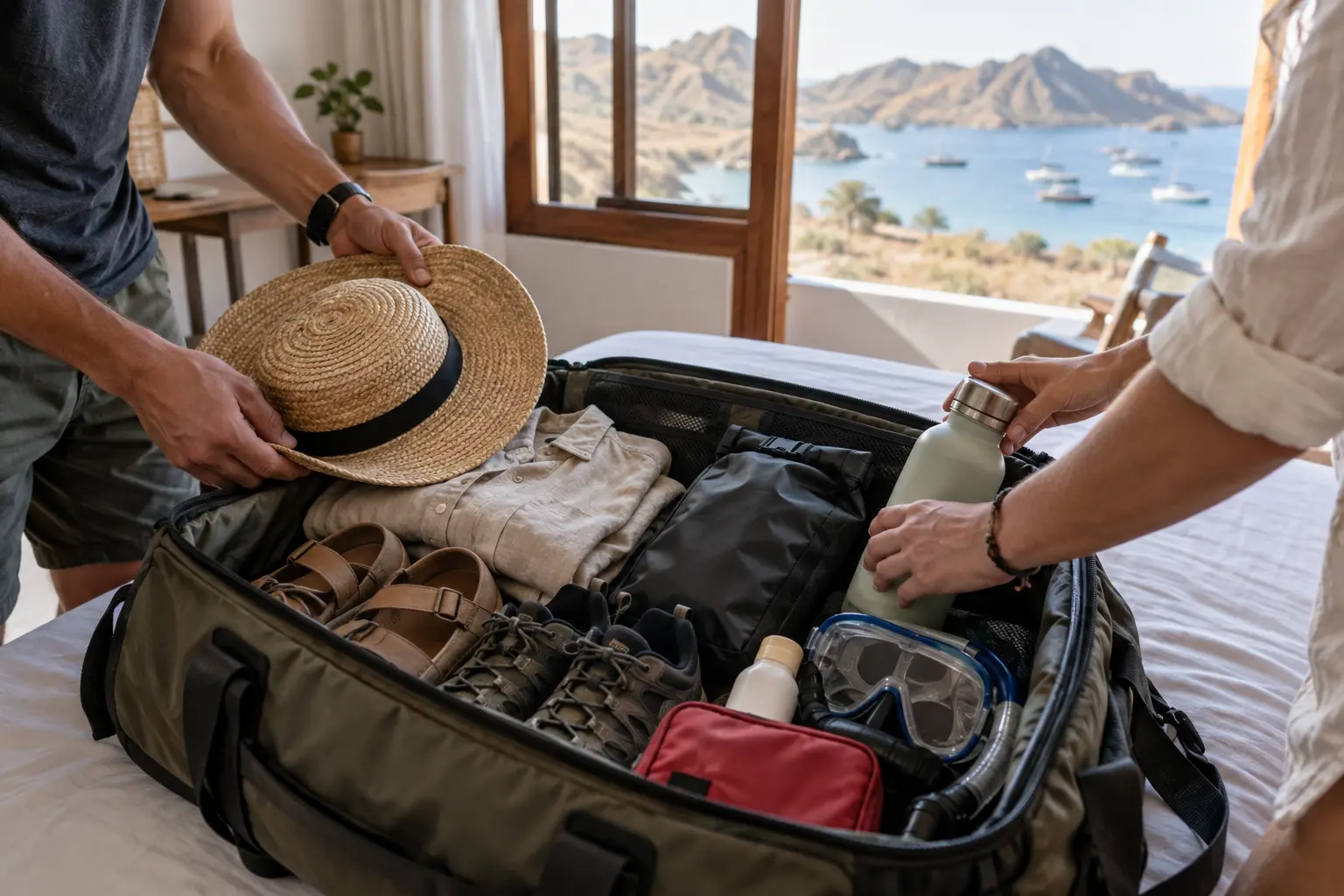
Pack light, pack soft, and pack for sun and salt rather than for cold. A Komodo trip is hot, bright and almost entirely outdoors, cabins are small, and there is nowhere to buy what you forgot once you sail. The things people most often wish they had brought are proper walking shoes, a dry bag, reef-safe sun protection and more rehydration than they expected.
The short version
If you read nothing else, this is the list that prevents the common problems.
| Essential | Useful | Optional |
|---|---|---|
| Passport and park reservation confirmation | Waterproof phone pouch | Underwater camera |
| Rupiah in cash, small notes | Quick-dry towel | Binoculars |
| High-factor, reef-safe sun protection | Rash guard or long-sleeve swim top | Snorkel of your own |
| Hat and sunglasses | Powerbank | Book or e-reader |
| Closed walking shoes with grip | Head torch | Travel hammock |
| Reusable water bottle | Motion-sickness remedy | Light windproof layer |
| Dry bag | Insect repellent | Playing cards |
| Personal medication | Soft duffel rather than a hard case | Dive computer, if you own one |
Documents and money
Carry your passport, a copy stored separately, your park reservation confirmation and your travel insurance details. If you dive, bring your certification card and logbook — operators do ask, and an unverifiable claim about your experience level is a safety problem rather than an administrative one.
Bring rupiah in cash, in small denominations. Cards work in hotels and with established operators and almost nowhere else, and ATMs in Labuan Bajo run empty or offline often enough that arriving with nothing is a real risk. Cash covers tips, incidental purchases, anything payable on the islands, and the taxi you did not plan for. Keep it in a dry bag on the boat — salt air and damp cabins are unkind to paper.
Sun and heat
This is the part most people underestimate. You are near the equator, on water, with reflected glare from every direction, for most of the daylight hours. Shade on a boat is limited and the deck is the best part of it.
- High-factor sun protection, applied more often than feels necessary. Choose a reef-safe formulation — you will be swimming directly over living coral, repeatedly.
- A hat that stays on in wind, ideally with a chin cord. A hat lost overboard is a hat gone.
- Sunglasses, with a strap if you value them.
- A long-sleeve rash guard. The single most effective piece of sun kit on a boat: it works while wet, it does not wash off, and it covers the hours when you have stopped reapplying.
- Lip balm with sun protection, which is the bit everybody forgets.
- Electrolyte sachets or rehydration salts. Heat and a full day outdoors dehydrate faster than thirst signals.
Footwear
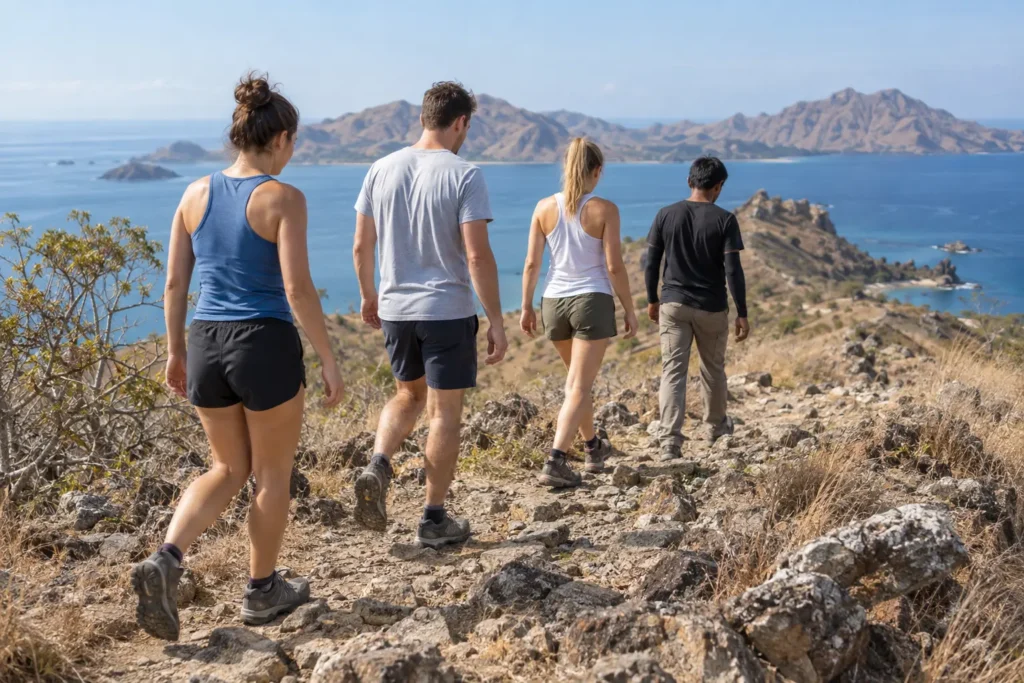
Two pairs is the right answer, and only one of them is the interesting one.
Closed shoes with real grip for the island walks. The Padar climb is a stepped and partly loose path done before dawn, and the dragon treks on Rinca and Komodo Island are over dry, rocky, uneven ground. Trainers or light trail shoes are ideal. Flip-flops on Padar is the mistake you will see someone else make.
Sandals or flip-flops for everything else, because most boats are barefoot aboard and you will be getting in and out of a tender all day.
Water shoes are worth considering if you have sensitive feet — some beach landings are over broken coral rubble — but they are a comfort item rather than a necessity.
Clothing
Think hot, humid, salty and casual. Nobody dresses up.
- Light, loose, quick-drying clothes — more T-shirts and shorts than days, because nothing dries well in humid sea air.
- Two swimsuits, so one is always dry.
- One long-sleeve top and one pair of long trousers, for evening insects and for cooler crossings after dark.
- A light windproof or rain layer. Open decks at speed are colder than the air temperature suggests, and even in the dry season a squall is possible.
- Modest cover-up for the island visits, which are a working national park rather than a beach club.
- A quick-dry towel of your own, even if the boat provides one — boat towels spend the day wet.
Swimming and snorkelling
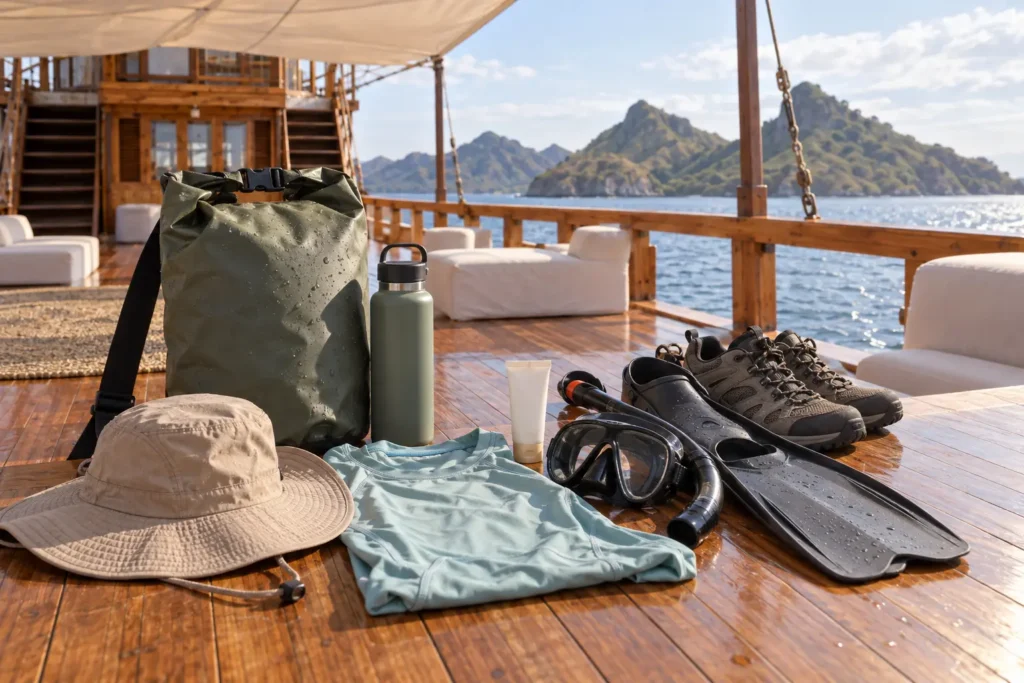
Most vessels carry snorkelling equipment, but fit and condition vary, and “provided” does not always mean “in good order”. If you snorkel often, bringing your own mask solves the single biggest comfort problem, because a leaking borrowed mask ruins a site you may only visit once.
Ask your operator specifically what is aboard: masks, snorkels, fins, wetsuits or shorties, flotation vests, and whether any of it carries a rental charge. Ask the same question about life jackets and safety equipment, and see the Komodo travel safety guide for what a credible answer sounds like.
If you are not a confident swimmer, say so before you book rather than at the first site. A buoyancy vest and a guide in the water make the difference between an enjoyable trip and a stressful one, and currents here are strong enough that this is not a matter of pride.
If you are diving
Dive operations differ more than leisure trips do, so the list is short and the questions matter more than the kit.
- Certification card and logbook, plus proof of any recent refresher if your last dive was a while ago.
- Your own mask and computer if you own them. Most divers prefer both, and a computer you know is safer than one you do not.
- A thicker exposure suit than the tropics suggest. Cool upwelling in the south of the park can drop water temperatures well below what people expect from Indonesia, and a cold diver is a short diver.
- A surface marker buoy and whistle if you have them — useful anywhere with current, and the boat may expect you to carry one.
- Your dive insurance details.
Confirm with the operator what rental gear is available in your size, whether nitrox is offered and what it costs, and how many guides are in the water per group. The Komodo diving hub covers what conditions to expect at different sites and levels.
Medication and personal health items
Bring what you already use, in enough quantity for the whole trip plus a buffer, in original packaging. There is a pharmacy and a clinic in Labuan Bajo, but there is nothing at all once you sail, and you should not assume a specific product is stocked.
A small personal kit typically covers: any prescription medication, painkillers, plasters and antiseptic for reef scrapes, rehydration salts, something for an upset stomach, and a motion-sickness remedy. Seasickness is worth preparing for even if you do not usually suffer — overnight anchorages roll, and the remedies that work are the ones taken before you feel unwell rather than after.
This is general travel preparation, not medical advice. If you have a condition that could be affected by heat, exertion, remote locations or diving, discuss the trip with your own doctor before you go, and tell your operator what they need to know.
Dry bag and electronics
Assume everything will get wet at some point, because tender transfers are a wet step and spray on an open deck is constant.
- A dry bag, 10 to 20 litres, is the most useful single item on this list after shoes.
- A waterproof phone pouch for tender rides and beach landings.
- A powerbank. Charging aboard varies by vessel and by time of day — some boats run generators only at certain hours, and sockets are shared.
- Check plug type and voltage with your operator rather than assuming; provision differs between boats.
- A head torch for early starts. The Padar climb begins in the dark, and phone torches occupy the hand you want on the path.
- Download offline maps, boarding passes and anything you need before you leave town. There is no usable signal inside the park.
Cabins, bags and what fits
Cabin space on a traditional phinisi is limited, and stowage under a bunk will not take a large wheeled case. Pack into a soft duffel or backpack that can be squashed flat once emptied.
Leave your main luggage at your hotel in Labuan Bajo — almost all of them store bags free for guests over a sailing — and take only what you need aboard. How that works on the day is covered in the getting to Labuan Bajo guide.
Cabin specification varies widely across the fleet, and it decides what you need to bring. Air conditioning is near-universal but hot water is not, so on a longer trip it is worth checking before you assume a hot shower. You can compare what individual vessels list on the liveaboard hub.
Seasonal additions
Wet season, roughly December to March
- A proper rain layer rather than a foldaway poncho.
- Extra dry bags — humidity alone keeps things damp.
- More insect repellent; standing water means more mosquitoes.
- Serious motion-sickness preparation, because this is when crossings are roughest.
- A spare set of dry clothes kept sealed, for the evening.
Dry season, roughly April to October
- More sun protection than you think, and more water.
- A buff or scarf for dust on the trekking paths.
- A warmer layer for July to September, when both the wind and the water are cooler than the brochure photographs suggest.
Which season you are packing for, and what it means for conditions, is set out in the best time to visit guide.
What not to bring, and what not to take home
- Drones, unless permitted in advance. Drone use carries a statutory charge and a permit process that must be completed before travel — see the park fees guide. Turning up with one and hoping is not an option.
- Single-use plastic. Bring a refillable bottle; most boats have a refill station.
- Anything you would be upset to lose overboard. Jewellery, in particular, has a way of leaving.
- Nothing from the park goes home with you. Coral, shells, sand and anything else living or once living stays where it is. This is a protected area, and removal is prohibited regardless of how it is offered or where it is found.
- Nothing goes into the sea either. Take rubbish back to the boat, including anything that blows off the deck.
The night before you sail
- Boat bag packed, main case ready to leave at the hotel.
- Passport, reservation confirmation and cash in the dry bag.
- Phone and powerbank charged; offline maps downloaded.
- Pickup time confirmed with the operator — if nobody has told you, ask.
- Anyone at home warned that you will be uncontactable.
- Sun protection and motion-sickness remedy in the day bag, not buried.
- Walking shoes accessible for an early start.
Frequently asked questions
What should I wear in Komodo National Park?
Light, quick-drying clothes, a long-sleeve rash guard for sun, and closed shoes with grip for the island walks. Bring a modest cover-up for the treks and a light windproof layer for open decks after dark.
Do I need hiking boots for Padar?
No, but you do need closed shoes with grip. Trainers or light trail shoes are ideal on a stepped, partly loose path climbed before dawn. Flip-flops are a poor idea.
Is snorkelling equipment provided on Komodo boats?
Usually, but fit and condition vary and some vessels charge for rental. Ask your operator exactly what is aboard. Bringing your own mask solves the most common comfort problem.
Can I bring a drone to Komodo?
Only with the permit arranged in advance. Drone use carries a statutory special-use charge per unit per day and requires the park’s permit process to be completed before you travel.
How much cash should I bring?
Enough rupiah in small notes to cover tips, incidentals and anything payable on the islands for the length of your trip, plus a margin. Withdraw before you reach Labuan Bajo rather than relying on ATMs there.
Do I need a wetsuit in Komodo?
For snorkelling, a rash guard is usually enough. For diving, bring more exposure protection than the tropics suggest — cool upwelling in the south of the park can make the water noticeably colder than expected.
What size bag should I take on a liveaboard?
A soft duffel or backpack that squashes flat. Cabin stowage will not take a large hard case, and your main luggage is better left at your hotel in Labuan Bajo.
