
Komodo Day Trip vs Liveaboard: Which Format Fits You?
Compare a Komodo day trip and liveaboard by time, pace, comfort, accessibility, traveler type and route limitations.

Day trip vs liveaboard at a glance
A day trip is a return journey from Labuan Bajo, normally using a speedboat to make the distance practical. A liveaboard combines transport, accommodation and activities across one or more nights. For your Komodo trip, that difference changes the pace, the amount of sea transit, the type of comfort you need and how early the day begins.
| Decision factor | Day trip | Liveaboard |
|---|---|---|
| Time needed | One long operating day plus a sensible flight buffer | At least one night onboard, commonly two or more |
| Departure pattern | Early departure from Labuan Bajo and return the same day | Board once, sleep inside the sailing area and continue the next morning |
| Pace | Fast transfers and a compressed activity schedule | More time overall, with the option to spread activities across days |
| Comfort base | Your hotel remains your bedroom and bathroom | Your selected cabin and the boat’s shared spaces become your base |
| Privacy | Depends on passenger load and whether the speedboat is shared or private | Depends on cabin allocation, guest capacity and shared or private booking |
| Sea time | Transit is concentrated into the same day | More total time onboard, often including overnight repositioning |
| Route limitations | Distance and daylight make a focused route essential | More time can widen route options, but conditions still control access |
| Best fit | Limited-time travelers who do not want to sleep at sea | Travelers who value the onboard experience and a multi-day rhythm |
Choose a day trip when one day is the honest limit

A day trip works because a speedboat turns a long sailing distance into a feasible return journey. The trade-off is intensity. You leave early, move quickly between a limited number of activities and spend a meaningful part of the day in transit. That can be an excellent choice when your hotel is comfortable, your time is fixed and you want a concentrated introduction to the park.
Do not treat a one-day itinerary as a smaller version of every multi-day route. Distance, daylight, sea state and park operations determine what fits. A responsible operator should explain which stops are planned and which may change.
A day trip suits you if
- You have only one full day available after allowing for flights.
- You prefer sleeping in a hotel rather than a compact boat cabin.
- You are comfortable with an early start and a long active day.
- You want a focused route rather than broad coverage.
- You have checked boarding access and speedboat seating for your needs.
Think twice if
- Fast movement, repeated transfers or a long return make the day hard for you.
- Your priority is quiet time at anchor or waking inside the park.
- You expect a remote or condition-sensitive stop to be guaranteed.
- Your group needs a slow pace or substantial schedule flexibility.
Choose a liveaboard when the overnight experience matters
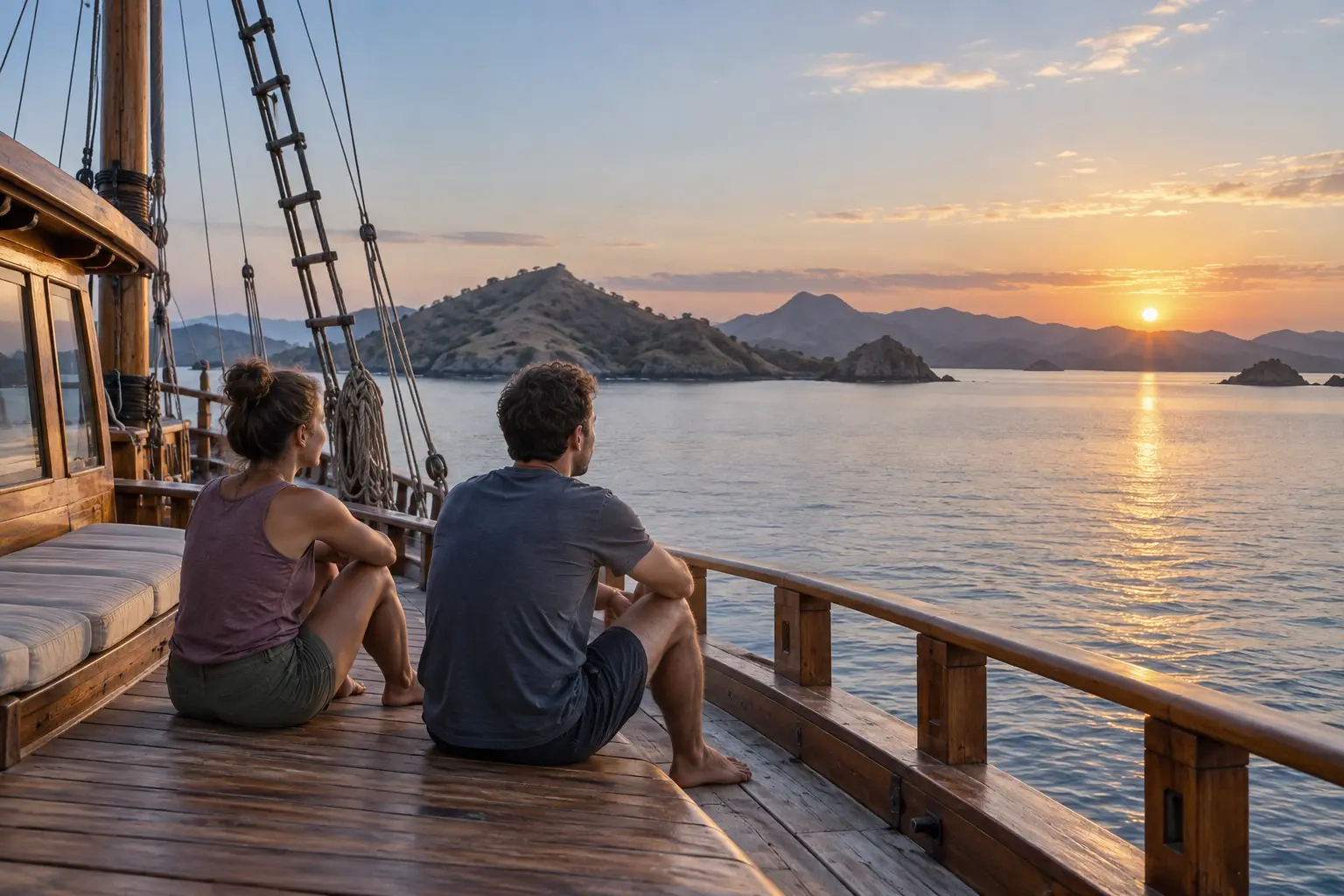
A liveaboard removes the daily return to Labuan Bajo. You sleep onboard, wake near the next activity area and experience the sailing time as part of the trip. That does not automatically mean luxury or a slow itinerary. Comfort depends on the actual cabin, bathroom, ventilation, guest capacity, crew, shared spaces and operating route.
The main benefit is a different use of time. Overnight positioning and earlier access to an activity area can reduce repeated backtracking. A multi-day itinerary also gives the operator more sequencing options, although weather, currents, park conditions and safety still override the plan.
A liveaboard suits you if
- You have at least two nights to give the trip and enjoy being on the water.
- You value sunrise, evening and overnight sailing moments.
- You want activities spread across several days.
- You are willing to compare cabins and vessel facilities carefully.
- You understand that the captain can change the route for safe operation.
Think twice if
- You strongly prefer hotel space, stable ground or a private land bathroom.
- You have not confirmed your cabin, bed, bathroom and air-conditioning setup.
- You are choosing only because a longer trip sounds more complete.
- An extra night at sea would make a flight connection or health need harder.
Comfort and accessibility are operational questions
Neither format is universally easier. A speedboat may reduce total days at sea but can involve concentrated motion and repeated steps between dock, boat and shore. A liveaboard may spread activities out but adds narrow stairs, tender transfers and nights in a marine environment. Ask for the actual boarding method, cabin deck, stair count, bathroom layout and tender arrangement.
For reduced mobility
Request photos or video of the exact access route. Confirm handrails, step height, wet landings, tender transfers and whether crew assistance changes the practical risk.
For seasickness
Ask about vessel size, cabin position, expected passages and sea conditions. A longer trip means more time onboard, while a day trip can concentrate higher-speed motion into one demanding day.
Decision scenarios by traveler type
Solo traveler
A shared liveaboard creates a natural social group and may offer more time to connect. A shared day trip is simpler when you only want one full day. Confirm single supplements and cabin-sharing rules before booking.
Couple
A day trip preserves your hotel comfort. A liveaboard makes the boat part of the experience. Compare the exact cabin and privacy level rather than assuming every overnight vessel is romantic.
Family
A day trip avoids sleeping onboard but can be a long, fast day. A liveaboard can spread the activity load, yet the boat must have a suitable cabin, safety equipment and child policy. Ask before choosing.
Group of friends
A private day charter can keep the commitment short. A private liveaboard gives the group more shared time and potential schedule input. In both cases, the captain controls safe operation.
Diver
Use a dedicated dive departure when the goal is diving. Confirm compressor or tank logistics, guide capacity, dive equipment, site plan and certification requirements. Start with the Komodo diving inventory.
Traveler with limited time
Choose the day trip if one full day is all you have. Do not squeeze a liveaboard between flights without the operator’s confirmed boarding and return schedule plus a sensible buffer.
Route coverage is possible, not promised
Multi-day boats can usually work with a larger operating window than a same-day return. That does not make every named destination available on every departure. Sea state, current direction, visitor management, ranger operations, boat speed and safety can all change the order or remove a stop.
Read the Komodo National Park planning guide for the wider destination context. Then compare the operator’s written plan with the actual Tour page and the Liveaboard listing. A route claim is stronger when it appears consistently across those sources.
Questions to ask before booking either format
Confirm the operating reality
- Which boat operates this exact departure?
- What are the meeting, boarding and return times and locations?
- Which stops are planned, and which depend on conditions?
- How many guests can be onboard, and how many are booked now?
- Is the booking shared, a cabin purchase, a passenger place or a whole-boat charter?
- What happens if weather, currents or park conditions change the route?
- Which park charges, transfers, meals and equipment are included?
- What access, safety or medical information does the operator need from you?
If you choose an overnight format, continue with the open trip vs private charter comparison. If you are still choosing a duration, compare the current the current 3D2N itinerary with the wider Komodo tour package hub.
Compare the parts of the day that cannot be moved
Ask for each operator’s actual harbor departure, first planned stop, time ashore and return window. A day boat can spend less time on accommodation logistics, while a multi-night boat can start a morning already near the islands. Neither statement proves a particular sunrise or wildlife sighting. At a fixed Padar sunrise, the overnight anchorage and the allowed trail access both matter; at a day-tour return, the last island-to-town crossing and the boat’s cutoff both matter. Have the operator mark which stops are essential and which would be dropped first if sea conditions change.
Compare the total holiday, too: a day trip usually needs hotel nights before and after, while an overnight sailing replaces some hotel nights but may have different park charges, room allocation and meal inclusions. Keep prices in the same unit and ask for an itemised quote. A faster speedboat does not automatically create a slower day ashore, and a longer sailing does not automatically give every guest a private cabin.
Frequently asked questions
Is a Komodo day trip worth it?
Yes, when you have one usable day, accept a fast schedule and choose a route that matches your priorities. It is a focused introduction, not a substitute for every multi-day experience.
Do I need a liveaboard to see Komodo dragons?
No. Day trips and multi-day trips can include a ranger-led dragon visit, subject to the operator’s route and local conditions. Check the exact Tour page rather than assuming.
Is a day trip better for seasickness?
Not automatically. It reduces the number of days onboard but can involve concentrated high-speed motion. Ask about the boat, sea passages and expected conditions, and seek medical advice when appropriate.
Is a liveaboard always more comfortable?
No. Comfort depends on the actual cabin, bathroom, ventilation, guest capacity, common spaces, crew and operating condition of the vessel. A good hotel plus day trip may be more comfortable for some travelers.
Which option is better for a family?
Choose after comparing activity pace, child policy, safety equipment, boarding access and cabin configuration. A longer trip can be calmer, but a long stay in a compact cabin may not suit every child.
Can either option guarantee Padar, mantas or a specific beach?
No responsible operator should guarantee a condition-sensitive experience. Routes and wildlife encounters depend on weather, currents, park operations and safety.
Methodology and freshness
This guide compares operating format, time use, comfort and traveler fit. It does not freeze prices, boat counts, wildlife sightings or route promises. Linked Tour and Liveaboard inventory remains the current source for available vessels and verified commercial details. Park access and advance reservation are described by the Ministry of Forestry; check the BMKG maritime tourism forecast for the travel date. Neither source guarantees an individual stop.
