
Anchors, Moorings and Coral Reefs in Komodo
Understand anchor and chain damage, what moorings can and cannot guarantee, and questions to ask Komodo boat operators.
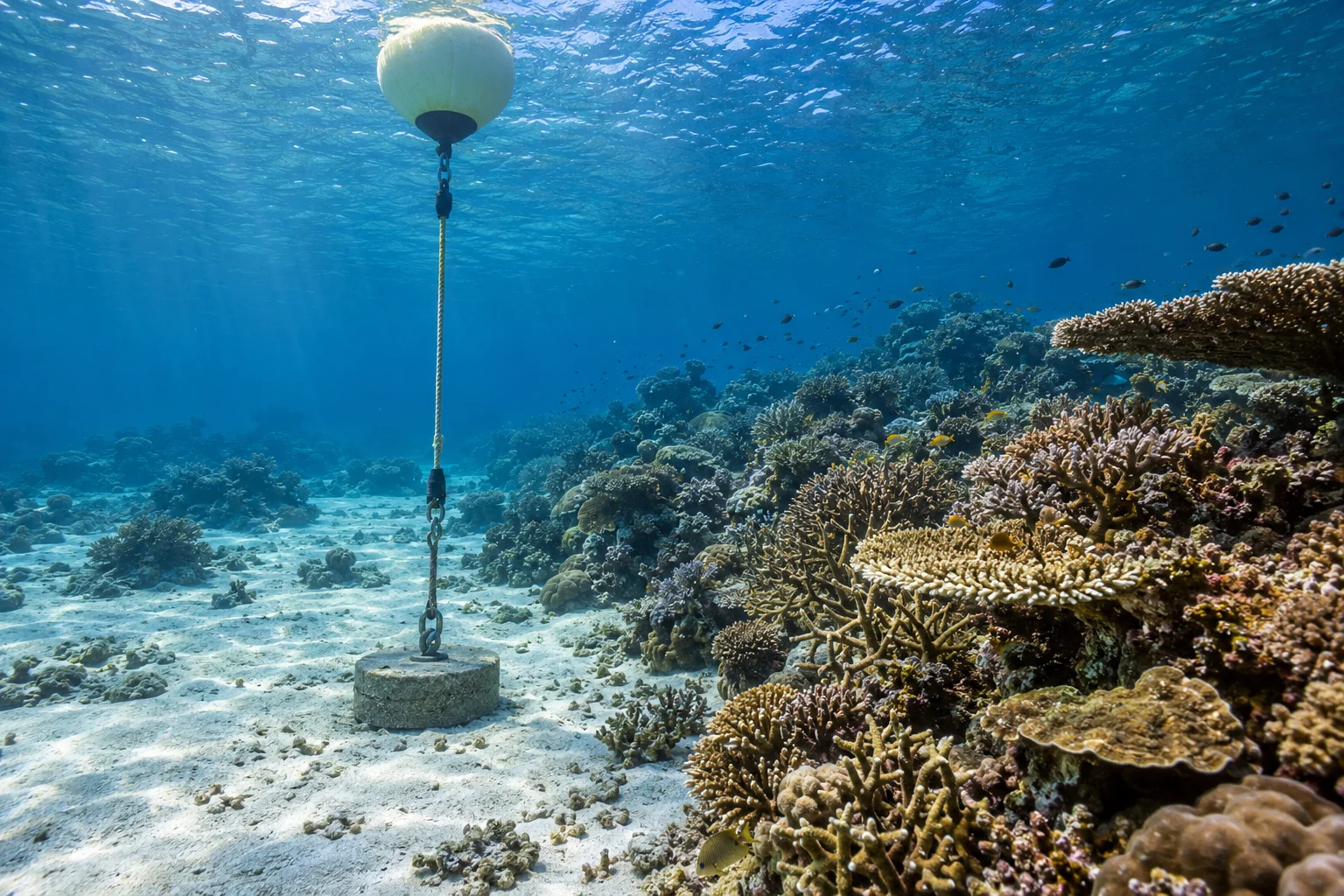
An anchor and its moving chain can damage coral or seagrass. A properly designed, maintained and appropriately used mooring can reduce the need to anchor on sensitive habitat, but the presence of a buoy alone does not establish that it is safe or suitable for a particular vessel.
Why the chain matters too
The anchor is only one part of the contact footprint. As a vessel moves, ground tackle can move across the bottom. A guest seeing the anchor land away from a coral head cannot necessarily see the whole area affected. Depth, swing, weather, seabed and vessel characteristics belong in the captain’s operational assessment.
This is not an anchoring manual. Visitors should ask about procedures and report concerns without directing a manoeuvre or handling equipment. A safe decision may be to use another authorised location or leave a crowded site.
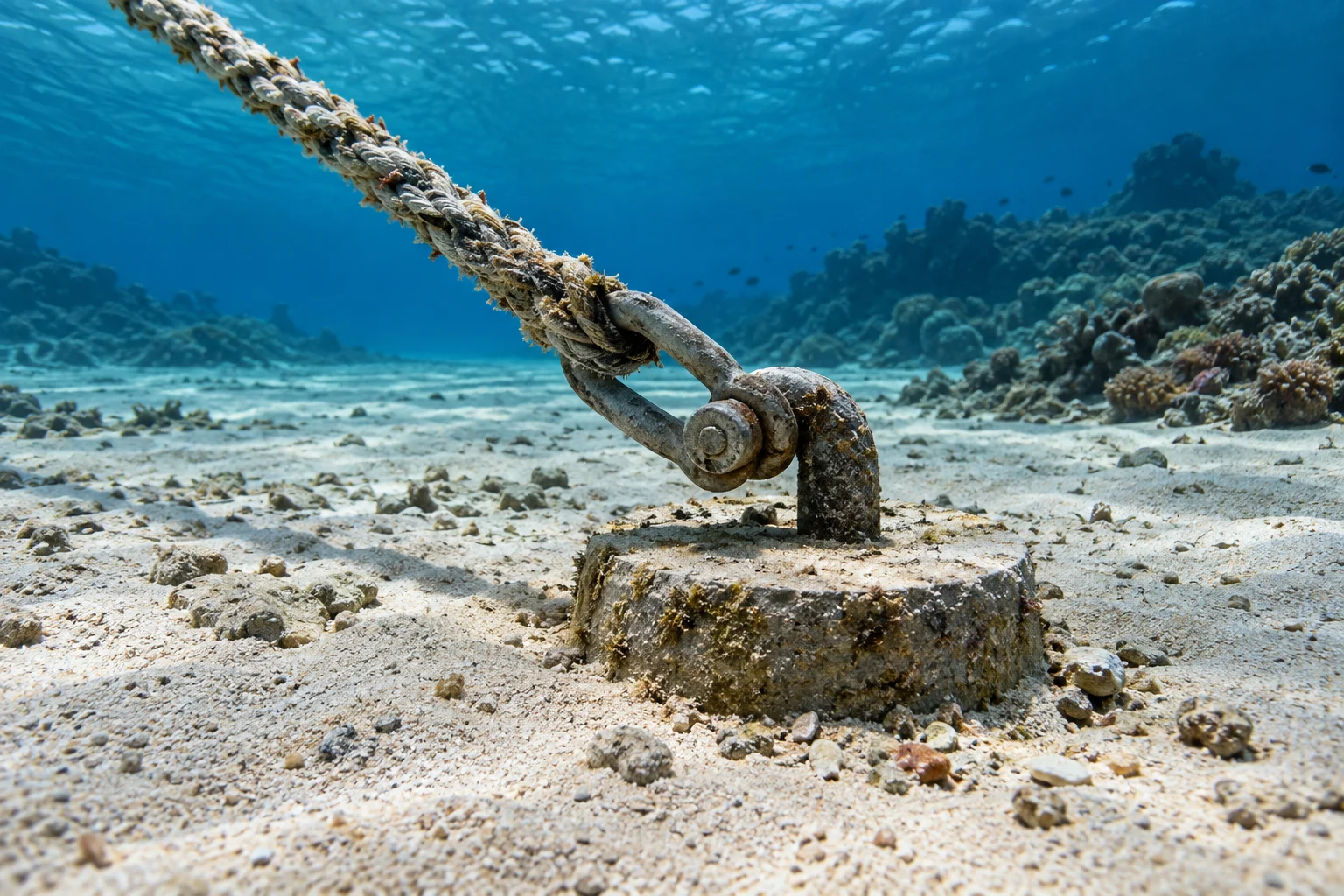
What a mooring can and cannot prove
| Question | Why it matters |
|---|---|
| Who manages the mooring? | Establishes responsibility and a route for reporting defects |
| What vessel limits apply? | A visible buoy does not reveal design capacity |
| When was it inspected? | Wear and damage can change suitability |
| Are conditions appropriate today? | Infrastructure does not remove weather and sea-state limits |
| What is the alternative if it is occupied? | Prevents pressure to improvise on sensitive habitat |
Historical programmes are not a live buoy inventory
The often-linked Komodo mooring-buoy programme page documents a management approach. It should not be used as proof that every described buoy remains present, maintained or available. Operational information needs a current source and local confirmation.
Reef-World’s January 2026 account of Komodo dive-operator coordination describes improving mooring buoys as an area of further work. It does not certify a complete park-wide mooring network. Its discussion of staggered entries also concerns crowding, a separate issue from the condition of ground tackle.
Questions that reveal the actual procedure
Before booking, ask how the captain identifies suitable moorings and what the crew does when the planned one is unavailable. Ask whether the vessel has a no-anchoring-on-coral policy and how that policy is implemented. A specific explanation is more useful than an assurance that the crew always cares for nature.
On board, listen to the reason for a changed stop. An operator willing to abandon a location when conditions or infrastructure are unsuitable is making a real operational choice. Guests can undermine that choice by insisting on a fixed photograph or threatening a complaint whenever a stop changes.
Documenting a concern without creating another risk
Do not enter the water near active manoeuvring to inspect an anchor. If a concern is visible from a safe position, note the date, site and vessel details, and describe what you saw. Separate an observed chain touching coral from an assumption about damage below the surface.
Raise the concern with the trip leader when safe. A useful follow-up asks what happened, what action was taken and whether the relevant manager was notified. Public accusations should not go beyond the available evidence. Repeated issues need a documented response, not just a replacement marketing slogan.
Choosing a reef-conscious departure
Compare anchoring policy alongside wildlife briefing, group control and waste handling when considering dive komodo departures. No single piece of infrastructure proves the environmental performance of the whole trip.
Does every buoy mark a visitor mooring?
No. Do not infer permission or suitability from appearance. The crew needs to identify its purpose and applicable conditions.
Is anchoring on sand always harmless?
A sandy appearance does not reveal every organism or the full swing area. Site rules and a competent operational assessment still matter.
Can a small boat cause damage?
Vessel size alone does not determine impact. Where equipment contacts the seabed and how it moves are also important.
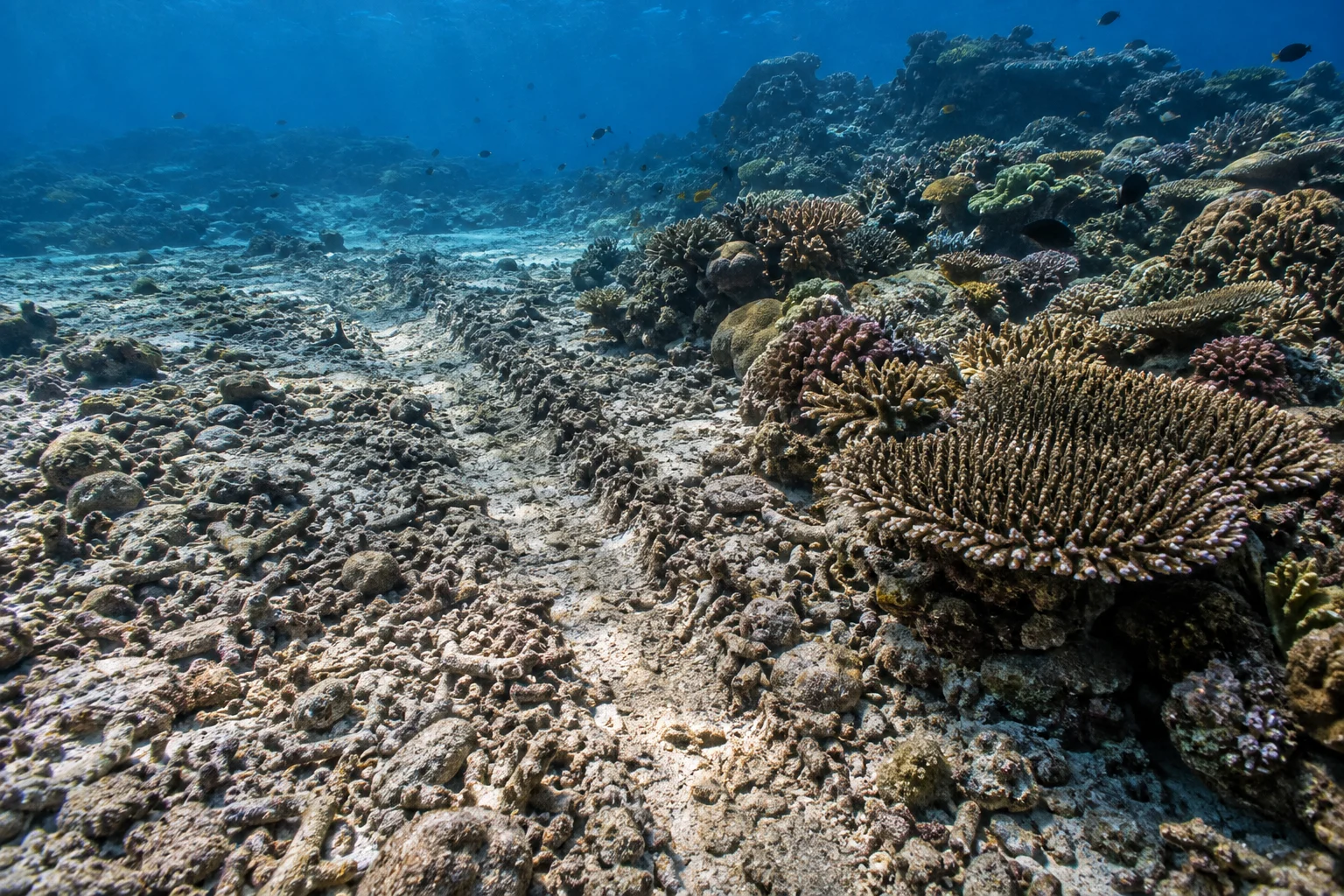
Ask what happens before the anchor drops
A useful answer identifies how the captain checks the bottom, whether a suitable mooring exists, and the fallback when the intended location is unavailable. A rope tied to a buoy does not establish that the buoy is authorised for visitor use. Include the chain’s sweep and retrieval in the discussion, not only the anchor’s landing point.
Ask how vessels protect reefs when comparing Komodo liveaboards, and match underwater activities to responsible operators through Dive Komodo.
Ask who makes the seabed decision
Before a reef stop, ask how the skipper selects a permitted mooring or anchoring location and what happens when a buoy is unavailable or unsuitable. The presence of a line in a photograph does not establish permission, load capacity or maintenance.
Keep guests away from working lines and do not enter the water to inspect or handle the system independently. Report a concern through the guide with the location and time. A historical mooring programme is useful context, not a current inventory for every bay.
Historical park surveys and natural-history publications are indexed in the Komodo research archive; retain each publication’s date and sampling limits rather than treating it as a current service or wildlife inventory.
