
Flying After Diving in Komodo: Plan Your Final Dives and Departure

Flying after diving in Komodo means counting from the last surfacing time, not from the boat’s arrival at the harbour. Ask for the final dive schedule before booking a flight, and allow extra margin for sea and flight disruption.
Illustrative timetable with a buffer
Suppose the last dive ends at 10:00 on Monday and your flight is 10:00 Tuesday. That is 24 hours on paper; an afternoon rescheduled dive would reduce it. Plan with the latest plausible finish and the actual departure time. A non-diving day can also leave room for gear drying, a relaxed return to port and a flight delay, but itinerary convenience does not substitute for individual medical guidance.
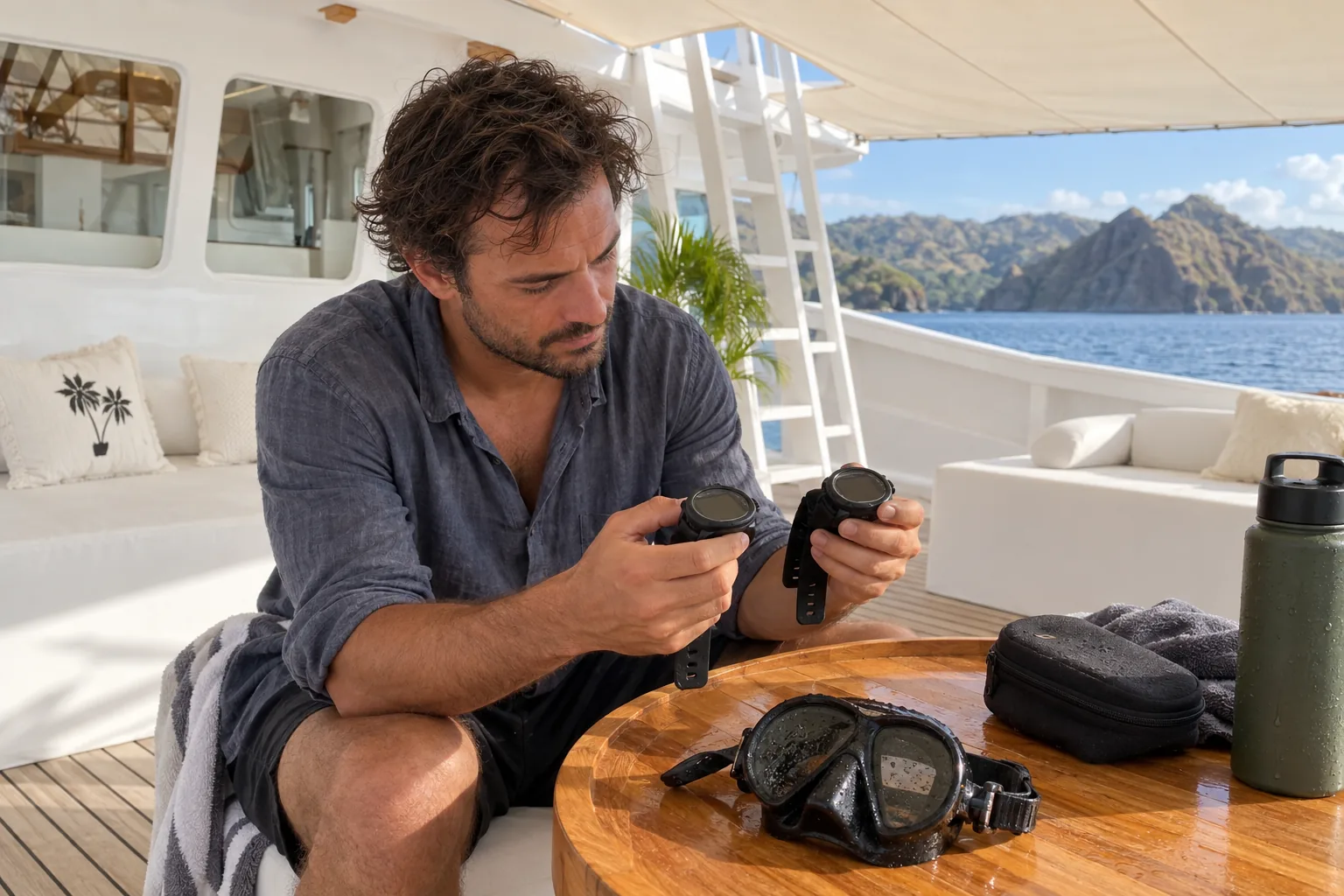
Count the correct interval
A flight is a lower-pressure exposure even if it is short. Record the time you actually surfaced from your last dive and the scheduled takeoff, then calculate the elapsed hours. The boat docking time, hotel checkout and calendar date do not start the clock. Allow a buffer beyond the minimum because the last dive can finish late and flights can be rescheduled.
DAN’s guidance distinguishes a single no-decompression dive from repetitive dives or several days of diving. If your profile involved mandatory decompression or unusual exposures, ordinary recreational minimums do not fit. Ask a qualified diving medical professional for individual advice and follow any more conservative operator rule. A dive computer’s “no fly” display can be useful but should not be treated as a universal medical certificate.

Choose which final-day activity to drop
One practical option is to plan a non-diving final day. Alternatively, a diver can skip the last scheduled dive after confirming that staying aboard is permitted and supervised. If the boat substitutes a later dive because of weather, revisit the flight calculation immediately. If the only flight is too close to the final surface time, change the dive or the flight before paying, rather than hoping for an early return.
Symptoms change the decision
If you develop symptoms potentially related to diving, seek medical assessment and avoid flying until appropriately evaluated. The clock-based minimum does not make a symptomatic diver fit to travel. The operator’s emergency plan should include how to contact medical advice and how to document the dive profile. This article cannot assess a person’s individual fitness to fly.
Booking checklist
Ask for the planned last dive, likely surfacing time, alternative if weather delays it, permission to sit out a dive, and the flight departure rather than merely the airport transfer. Put the resulting buffer in the itinerary shared with everyone booking flights. This is especially important when a liveaboard ends on the same day guests leave Labuan Bajo.
Use the relevant guidance
DAN consensus guidance recommends at least 12 hours after one no-decompression dive and 18 hours after repetitive or multi-day no-decompression diving. Obligatory decompression or certain gases require substantially longer. These are minimum recommendations for the specified profiles, not universal medical clearance.
| Input | Why it matters |
|---|---|
| Actual final surfacing | Starts the interval. |
| Dives over preceding days | Changes the relevant category. |
| Altitude and flight timing | Changes pressure exposure after diving. |
| Symptoms or unusual dives | Call for qualified medical advice, not a calculator. |
A practical example
If the final surfacing is at 11:00 and a flight leaves at 22:00, only 11 hours have passed. That does not meet the 18-hour minimum for multi-day repetitive no-decompression diving. The calculation is illustrative and does not suggest booking a flight exactly at a minimum threshold. Omit a last dive or depart later with a useful buffer.
Questions for the boat
- When will the planned final dive finish?
- Can a guest decline that dive and stay safely aboard?
- What changes if weather shifts the dive later?
- How does the operator handle a dive with decompression obligations?
- What is the plan if someone develops symptoms?
Commercial guides from Komodo Resort and Neptune Liveaboards explain itinerary timing. Use the medical source above for interval guidance. Review dive komodo for route context and confirm the actual dive profile and last surfacing with the operator.
Use our guide to how many days to spend in Komodo when building the final no-dive window into the itinerary.
Calculate the interval from two exact timestamps
Use an example with clearly labelled local times: a final dive ending Monday at 14:00 and a Tuesday flight at 10:00 leaves 20 hours. That is arithmetic, not medical clearance. Check the actual profile, computer guidance and professional advice; extending the interval may be necessary.
Do not replace a no-fly period with a mountain drive automatically. Discuss altitude as well as the flight when choosing the final land day. A person with symptoms that may indicate decompression sickness needs medical advice and should not fly simply because a nominal interval has elapsed.
Does one hotel night guarantee enough time before flying?
No. Measure from the end of the final dive to the flight and apply the appropriate guidance. The label overnight does not specify a number of hours.
Read the full conditions and limits in DAN’s flying-after-diving guidance.
