
Komodo Travel Safety Guide
The risks that actually matter on a Komodo trip, how to judge an operator, and the honest limits of help once you are inside the park.
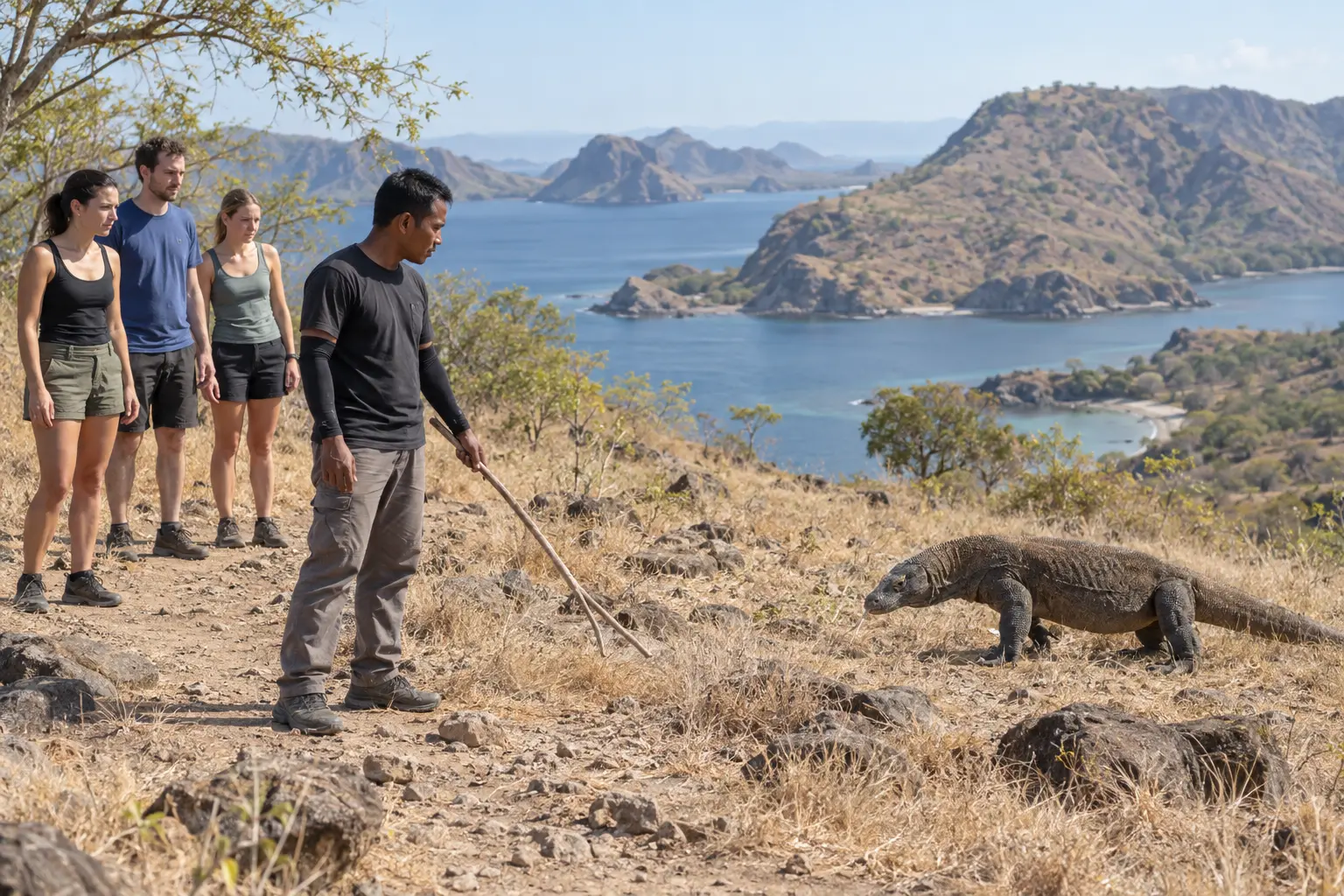
Komodo is a normal, safe trip for most travellers, and the risks that matter are not the ones people worry about. Dragons are managed with rangers and distance rules. What actually causes problems is water — strong currents, tender transfers and swimming beyond your ability — along with heat, the early climb on Padar, and being hours from medical help with no phone signal. Choosing a credible operator does more for your safety than anything you can pack.
Choosing a credible operator
This is the decision that carries the most safety weight, and it is made weeks before you travel, from a screen, on incomplete information. Price is the loudest signal and the least useful one.
What to look for:
- They answer specific questions specifically. Ask how many life jackets are aboard, how many crew, what happens if the weather turns. A good operator answers with numbers. A weak one answers with reassurance.
- They ask you questions too — swimming ability, diving experience, medical conditions, ages in the party. An operator who wants none of that is not planning around you.
- They put the itinerary in writing, including what is not included, and they describe route changes as normal rather than unthinkable.
- They have a named business, a traceable address and a consistent identity across their own site and their listings.
- They do not guarantee wildlife. Anyone promising you will see mantas, dragons behaving a particular way, or whale sharks is selling something they do not control.
Be wary of a price far below the rest of the market for the same length and vessel class. Somewhere in that gap is usually crew numbers, maintenance, equipment or insurance.
Vessel and departure checks
You are not going to survey a boat, and you should not pretend to. But there are things a non-expert can notice on boarding morning, and there are questions worth asking before you pay.
Before booking, ask: how many crew; whether there are enough life jackets for everyone aboard including crew, and where they are stowed; what safety equipment the vessel carries; whether there is a life raft and what capacity; how the crew communicates when there is no mobile signal; and what the procedure is if someone is injured at a site.
On the day, notice: whether a safety briefing happens at all and whether it covers the muster point and the tender procedure; whether life jackets are accessible rather than buried; whether the tender is overloaded; and whether anyone counts heads getting on and off. A crew that counts is a crew that is paying attention.
If the briefing does not happen, ask for it. It is a reasonable request and the answer tells you a great deal.
Weather, sailing approvals and route changes
The most important thing to understand about Komodo weather is that whether you sail is not entirely your operator’s decision.
BMKG, the Indonesian meteorological agency, issues marine early warnings for these waters. When the forecast is dangerous, the Labuan Bajo harbourmaster — KSOP — can restrict or refuse sailing approval and close routes into the park. That happened in September 2026, when forecast waves of 1.5 to 3 metres and winds of 20 to 30 knots led to routes toward Padar and the national park being closed temporarily, with several specific channels and island waters named as dangerous.
Two consequences worth internalising:
- A cancelled or shortened trip is sometimes the system working. An operator who sails anyway is not being brave.
- Itinerary changes are normal. Swapping an exposed site for a sheltered one is routine seamanship, not a downgrade. Judge an operator by how early and how clearly they tell you, not by whether it happens.
Build a buffer day into wet-season trips, and never book a same-day onward international flight. Which months carry the most disruption is covered in the best time to visit guide.
Currents and swimming
This is the real hazard in Komodo, and it is badly understood by visitors because it is invisible from the deck.
The park sits in a strait between two seas, and enormous volumes of water move through narrow channels with the tide. Currents can run hard, change direction through the day, and be strong at a site that looked calm twenty minutes earlier. Some of the best-known snorkelling and diving locations are best-known precisely because that water movement brings the life.
What this means for you:
- Enter and leave the water where and when the crew tells you. The timing is not arbitrary; it is tied to the tide.
- Do not swim away from the group to get a better look. Distance opens faster than you can close it.
- Wear the flotation the crew offers, even if you swim well. It costs nothing and it changes the outcome if you tire.
- If you are caught in current, do not fight it. Signal, stay on the surface, keep your mask on and let the boat come to you. Swimming against moving water exhausts strong swimmers quickly.
- Say up front if you are not a confident swimmer. This is the single most useful disclosure you can make, and good crews plan around it.
Snorkelling
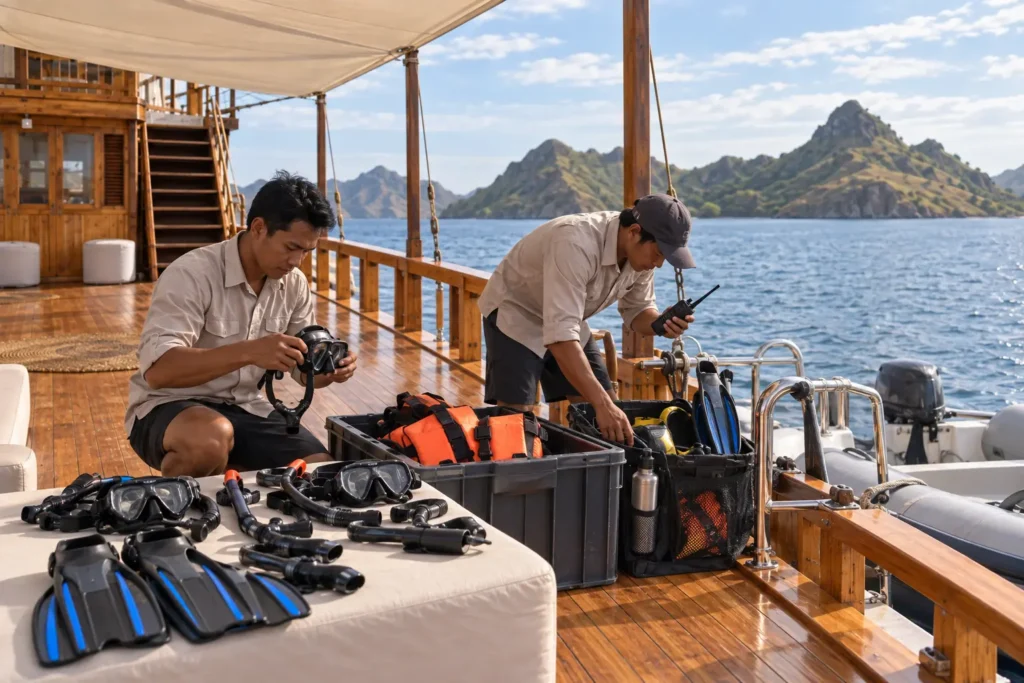
Most trips are snorkelling trips, and most incidents are avoidable ones.
Check your mask seals before you get in rather than at the surface. Go with a buddy and agree where the boat is. Keep fins clear of coral — both for the reef and because coral cuts in the tropics infect readily. Watch your sun exposure: a snorkeller floating face-down for an hour burns their back badly without noticing, and a rash guard prevents it.
If you are out of breath, cold, or uneasy, get out. There is another site later.
Diving
Diving in Komodo is a different activity with a different risk profile, and it sits outside what a general travel guide should advise on. Current-swept sites here are genuinely demanding, and several are not appropriate for newly certified divers regardless of how they are marketed.
Your dive professional’s briefing is the authority, not this page. What belongs here is the planning-level point: be honest about your certification and recent experience, bring your logbook, do a refresher if it has been a while, and choose an operator who matches sites to divers rather than the reverse. What conditions to expect, and which sites suit which level, is covered on the Komodo diving hub.
Arrange dive-specific insurance, and confirm with your operator what their evacuation plan is and where the nearest treatment facility is on your dates. Do not fly within the interval your training and your computer specify after your last dive — on a trip that ends the morning of a flight, that constraint is real.
Padar, treks and hiking
The Padar climb is short but it is a genuine effort: steps and loose ground, started in the dark, finished as the sun and the heat arrive. People turn ankles on the way down more often than they struggle on the way up.
- Closed shoes with grip, and a head torch rather than a phone.
- Carry water up, not just to the top.
- Stay on the marked path. The loose ground either side is the reason the path exists.
- Go at your own pace, and turn back if it is not working. The lower viewpoints are good.
- If you have a knee, heart or breathing condition affected by exertion in heat, take advice from your own doctor before the trip rather than deciding on the beach.
The dragon treks on Rinca and Komodo Island are flatter but hotter, over dry rocky ground with little shade.
Rangers and wildlife distance
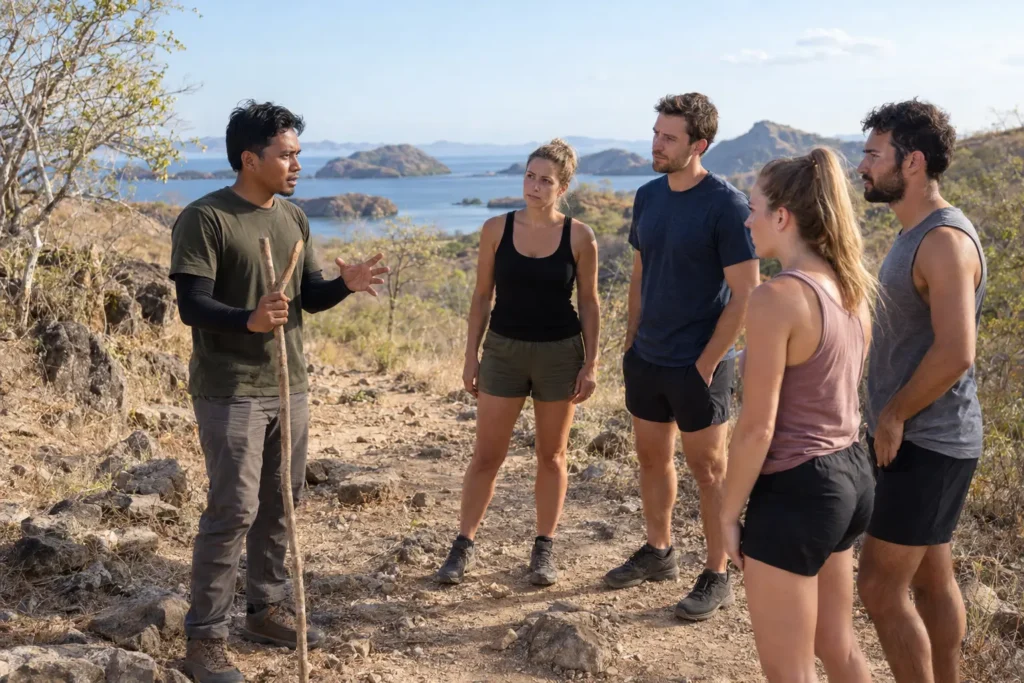
Treks on the dragon islands are made in the company of a park ranger. Their instructions are not advisory, and the distance they set is not a suggestion.
Komodo dragons are large wild predators. Attacks on visitors are rare, and they are rare because the system of rangers, distance and group discipline works — not because the animals are tame.
- Stay with the group and behind the ranger.
- Keep the distance you are given, including for photographs. No picture is worth closing it.
- Never feed, bait or attempt to attract any animal.
- Move calmly. Do not run, and do not crouch or lie down for a camera angle.
- Tell your guide before the trek if anyone in the party has an open wound or is menstruating — rangers ask about this for a reason, and it is a normal question rather than an intrusive one.
- The same distance principle applies in the water. Do not touch, chase or block the path of mantas, turtles, sharks or anything else.
Tender transfers
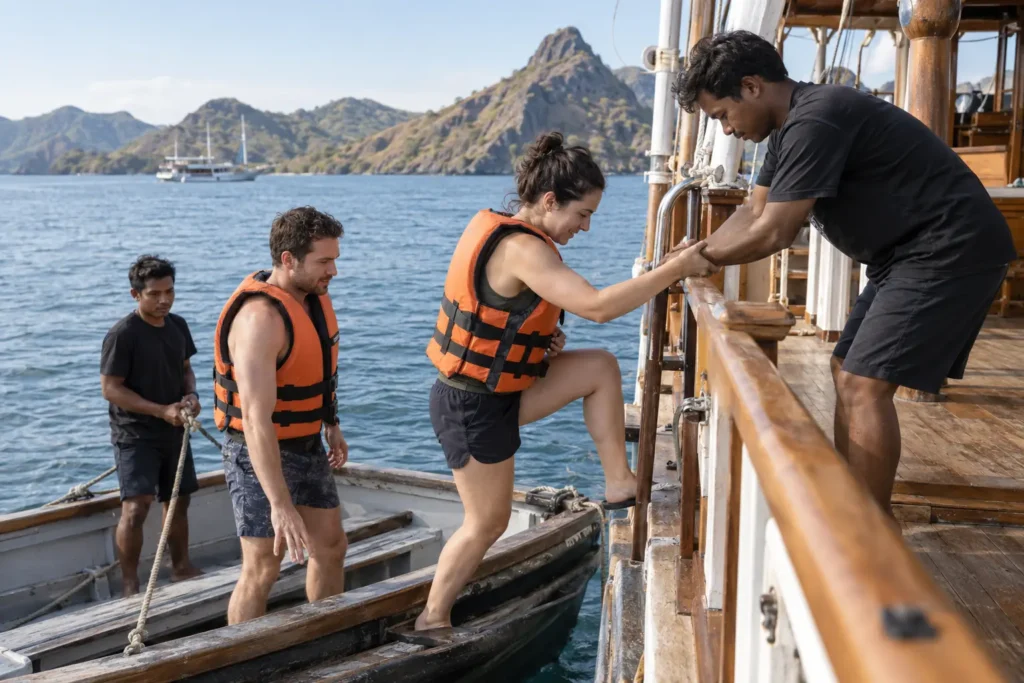
The small boat between the vessel and the shore is where most minor injuries on these trips happen, and it is the part nobody thinks about.
Move one at a time. Keep both hands free — pass bags across rather than carrying them. Sit down as soon as you are aboard and stay seated. Expect the step to be wet and moving, and take the crew’s hand when it is offered. At night or in swell, wait to be told rather than deciding yourself.
Seasickness
Not dangerous, but it can ruin a trip, and badly dehydrated people make poor decisions in heat.
Remedies work best taken before you feel unwell, so if you are at all prone, start before you sail rather than after the first crossing. On deck in fresh air with a view of the horizon beats lying in a cabin. Keep taking fluids in small amounts. If someone in the party cannot keep water down for an extended period, tell the crew — that is a situation to manage, not to tough out.
Children, older travellers and limited mobility
Komodo works for all three, with planning, and works badly for all three as an afterthought.
The constraints are consistent: boarding is by tender from a moving platform; the trekking ground is uneven; there is limited shade; and nothing about the schedule is close to medical help. Longer trips are gentler than short ones, because the same stops are spread over more mornings — see the how many days in Komodo guide.
Tell the operator who is travelling before you book, not on the pier. Ask specifically how boarding works for someone with limited mobility, whether child-size flotation is aboard, and whether the crew is comfortable with the ages in your group. A straight answer, including a straight no, is worth more than an accommodating one.
Heat, sun and dehydration
You are near the equator, on water, outdoors all day. Heat exhaustion creeps up on people who are enjoying themselves.
Drink more than you feel you need and add electrolytes on trekking days. Use shade in the middle of the day rather than the deck. Reapply sun protection more often than you think, and cover up rather than relying on it alone. The early starts are partly a safety measure: the Padar climb and the dragon treks are scheduled before the heat for good reason. What to bring is in the packing guide.
Communication, medical help and the honest limits
This is the part that changes how you should think about everything above.
There is effectively no mobile signal inside the park — the park’s own reservation guidance advises completing bookings before travel for exactly this reason. Vessels communicate by radio and by satellite where they carry it. If something happens at a remote site, help is not minutes away; it is a boat journey to Labuan Bajo, where medical facilities are those of a small regional town, and onward transfer from there.
That does not make the trip unsafe. It makes preparation matter more than it would somewhere with a hospital down the road:
- Bring your own medication in sufficient quantity, in original packaging.
- Tell the crew about any condition they might need to act on, before you sail.
- Ask the operator what their evacuation procedure is and what communications the vessel carries.
- Leave your itinerary with someone at home, and tell them you will be out of contact.
Travel insurance
Check three things specifically rather than assuming a standard policy covers this trip:
- Medical evacuation from a remote marine location, which is the expensive scenario and the one most often excluded or capped.
- Scuba diving, if you dive — to the depth and certification you will actually be diving at, and including chamber treatment.
- Trip disruption from weather, including a sailing suspended by the authorities rather than by your operator, which is not always treated the same way.
Read what is excluded, not what is advertised, and take the policy details with you.
Questions to ask before you book
- How many crew, and how many guests, on my departure?
- Are there life jackets for everyone aboard, and where are they kept?
- What safety and communication equipment does the vessel carry?
- Is there a safety briefing before departure?
- What happens if the weather changes the route, or if sailing approval is withheld?
- What is your procedure if someone is injured or ill at a site?
- Is snorkelling equipment provided, and is there flotation for weaker swimmers?
- Are the park reservation and fees included, and for how many days?
- Who is the guide in the water, and how many guests per guide?
- What do you need to know about the people in my party?
Once you are comparing specific trips, the Komodo tour hub sets out the packages and the liveaboard hub lists what each vessel publishes about its crew, facilities and equipment. Background on the park and its rules is on the Komodo National Park pillar.
Frequently asked questions
Is Komodo National Park safe to visit?
For most travellers, yes, with a credible operator and ordinary care. The risks that matter are water-related — currents, tender transfers, swimming ability — plus heat and the distance from medical help, rather than the dragons.
Are Komodo dragons dangerous to tourists?
They are large wild predators and should be treated as such, but incidents involving visitors are rare. That record rests on rangers, enforced distance and group discipline. Follow your ranger’s instructions and keep the distance you are given, including for photographs.
Is it safe to swim in Komodo?
At the sites and times your crew chooses, yes. Currents through the channels can be strong and change with the tide, so enter and exit where you are told, stay with the group, and wear the flotation offered if you are at all unsure.
Do Komodo boat trips get cancelled for weather?
Yes, and the decision is not always the operator’s. When BMKG forecasts dangerous seas, the Labuan Bajo harbourmaster can restrict sailing approvals and close routes into the park. Build a buffer day into wet-season trips.
Is there phone signal in Komodo National Park?
Effectively no. Download what you need before you sail, tell people at home you will be out of contact, and ask your operator what communications the vessel carries.
Is Komodo suitable for children?
It can be, with the right boat and a longer, slower itinerary. Boarding is by tender, the trekking ground is uneven and there is little shade, so tell the operator the ages in your party before booking and ask how they handle them.
What travel insurance do I need for Komodo?
One that explicitly covers medical evacuation from a remote marine location, plus diving to your actual certification and depth if you dive, and weather-related trip disruption. Check the exclusions rather than the headline cover.
