
Underwater Photography in Komodo: Wide Angle, Macro and Current-Aware Planning

Underwater photography in Komodo starts with a dive plan, not a camera purchase. Choose wide angle when a site and conditions suit larger subjects, or macro when a slow sheltered dive fits both the subject and your buoyancy. A strong current or an unsettled group is a reason to leave the camera on the boat.
Choose the subject before you choose the rig
A manta station, a reef scene and a camouflaged nudibranch reward different approaches. A wide-angle housing is useful when the subject is large and you can keep safe distance without chasing it. A macro setup helps with small, stationary life where the guide can allocate time and everyone can hover without touching the habitat. Switching lenses on deck is easier than wishing you could change the group’s route underwater.
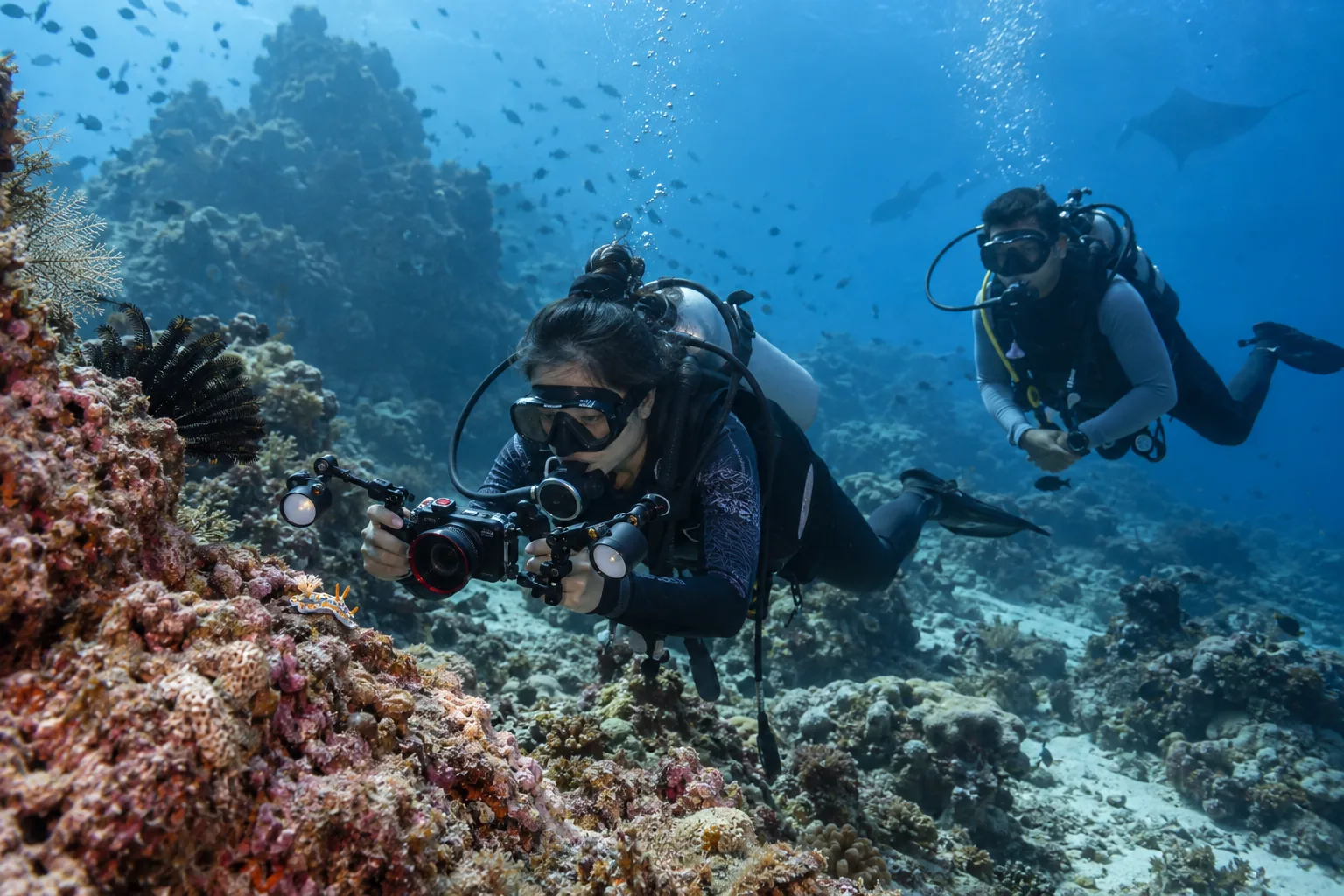
Choose a camera setup you can manage underwater
Wide-angle scenes reward a camera that can frame a large subject while you remain at a respectful distance. Macro requires stable position, patient focusing and careful fin placement; it becomes a poor choice if the photographer must touch or hover over living coral. A compact camera with reliable controls can be more useful than a large housing whose strobes and arms distract from buoyancy. Ask the dive guide what type of scene is plausible at the planned site, not which animal is guaranteed.
Before departure, test the housing’s seal in a controlled setting according to the maker’s instructions, inspect O-rings for damage and contamination, check battery and card capacity, and bring a secure lanyard that does not trail across reef. Never open a housing with wet hands over the camera. Check whether charging and safe dry storage are available on the named vessel.
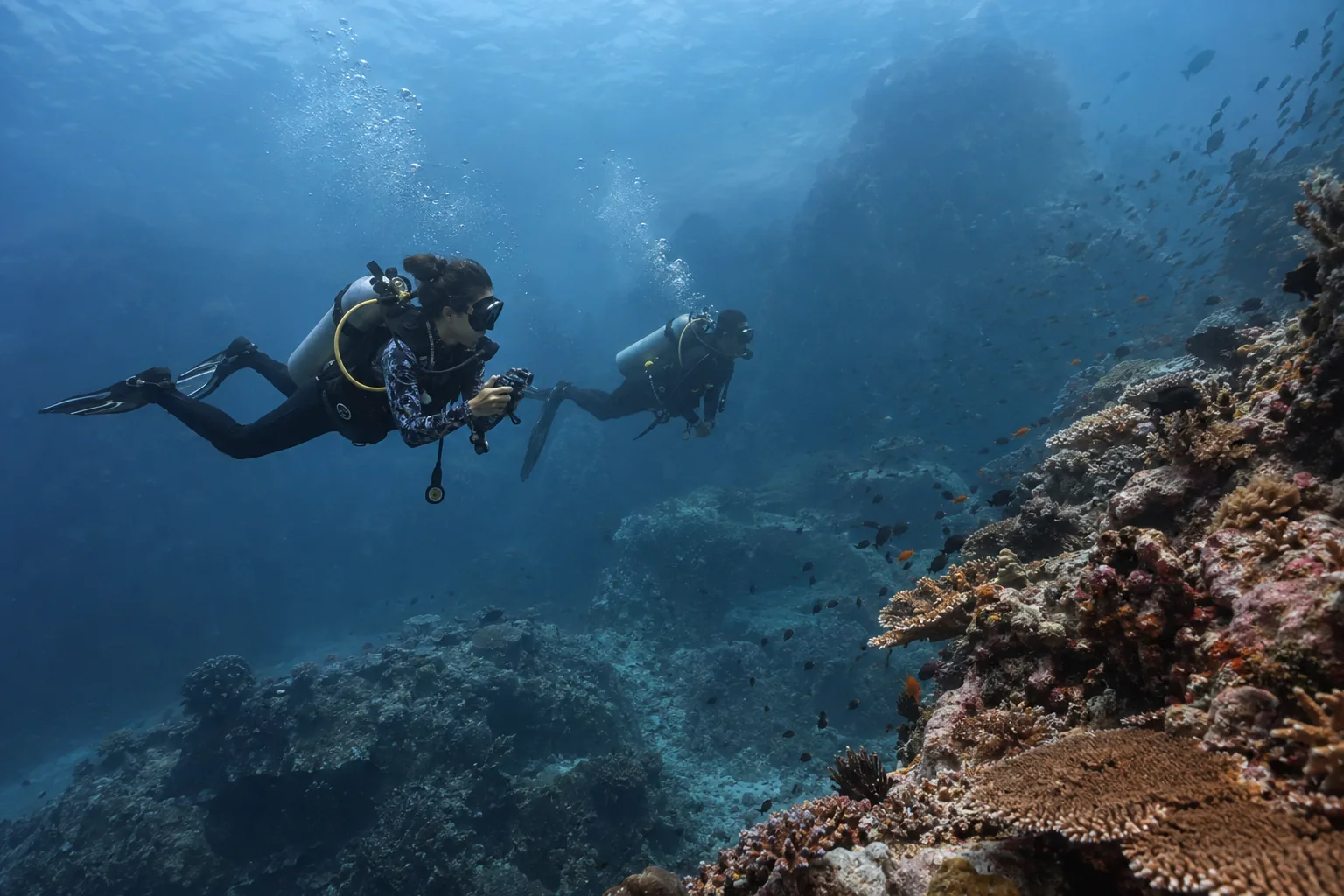
Make a dive plan before an image plan
Agree with the guide on group position, turnaround criteria, depth and pickup. In moving water, keep one hand available for signals and equipment rather than trying to reconfigure heavy arms mid-dive. If the group moves on, leave the shot. A manta or shark encounter is governed by wildlife distance and the dive plan; chasing it often produces a worse photograph and an avoidable separation.
Decide whether the camera will be carried on the first dive at all. For a diver returning after a long gap, a gear check and straightforward orientation dive can reveal whether task loading is manageable. Never solve poor buoyancy by anchoring on a reef. On a boat, clarify where the camera is handed down and recovered so its weight does not interfere with ladder use.
Shot selection without disturbing animals
For macro, look for subjects on a stable background and maintain distance while your guide checks the route. Do not move animals, break a branch or use repeated flash on a stressed animal to force a frame. For wide scenes, include habitat and scale without getting in another diver’s path. Record the site and conditions with each image; a caption that names a verified species and place is more informative than a generic “Komodo underwater” label.
| What you hope to photograph | Ask the guide first | What can go wrong |
|---|---|---|
| Mantas or schooling fish | Will we visit a site suitable for the group today? Where should photographers hold position? | Chasing wildlife or lagging behind a moving buddy group. |
| Reef panoramas | What is the likely current and safe position for a stable shot? | Finning into living coral while framing. |
| Small macro subjects | Is a slow habitat-focused dive possible without holding the rest of the group? | Stirring sediment, manipulating animals or monopolising the guide. |
Current changes what a photo is worth
At current-sensitive sites, the entry, route and retrieval are the priorities. Ask whether the camera may be handed down from the boat, whether both hands must remain available for an entry and how the guide signals that it is time to move. If your buoyancy changes when you use a housing, practise on an easier site. Do not attach a camera, reel or light to live coral to hold position. PADI’s photography guidance places buoyancy and respect for marine life ahead of getting the frame.
Prepare a two-dive decision rather than one heroic dive
Dive one: learn the group’s pace, entry and exit, and the way the current behaves. Capture a few shots only if the dive remains controlled. Dive two: ask for an appropriate subject and lens after you know the conditions. On a mixed-ability boat, agree on a time limit and a turn-back signal in the briefing so photography does not determine everyone else’s dive.
Before departure, charge safely, check housing seals, secure accessories and ask whether the vessel has a camera table, rinse procedure and protected charging area. A photo trip can fail from a lost cable or flat battery long before a missing lens matters. Clarify where the camera goes during tender transfers and rough crossings.
Make the experience claim checkable
Ask the operator for a sample dive plan that includes likely zone, subjects, guide-to-guest ratio, a slower macro option and a weather fallback. Do not ask them to guarantee mantas or a specific site. If a photographer is committed to large wide-angle subjects and the route turns into sheltered macro dives, the ethical solution is to change the shot list, not pressure the guide to enter unsuitable water.
Use the dive komodo listings to shortlist appropriate multi-day routes. Verify that a particular sailing has the dive staff, camera handling and itinerary needed; the vessel’s photo gallery is not evidence of the current departure programme.
Match camera setup and experience to the best dive sites in Komodo rather than choosing a site for images alone.
No portfolio, EXIF record or on-site photographer interview has been supplied for this article. Subject examples describe possible plans, not guaranteed sightings.
Build the photograph around the available dive
Before entry, choose one achievable subject approach: a wide scene that needs room and positioning, or a smaller subject that needs stable observation time. Ask the guide whether the site and group pace support it. Bringing both setups does not make both plans compatible with the same dive.
A useful image record includes date, site as confirmed by the guide, depth if known and the identification confidence. Avoid converting a visually striking frame into a claim about abundance or a guaranteed species. If the picture would require touching, blocking another diver or losing the group, let the picture go.
Does a photography itinerary guarantee a particular subject?
No. Compare pace, guide arrangements and suitable habitat, while treating wildlife presence and conditions as variable.
For independent diving and water-safety reading, use DAN’s Safety & Prevention resources; these do not inspect or endorse a particular Komodo departure.
